Showing posts with label fitness. Show all posts

Tuesday, September 26, 2017

I'm Under The Bus And I Can't Get Up

When it comes to initiating positive change in our own lives, why do things get hard?

Often when we’re trying to make positive changes in our life, there comes a point when we get stuck. We have a plan, we know the steps, we know what we're supposed to do. We start strong, we're on track for a day, a week, a month... but somewhere along the way we lose focus, we lose sight of the big picture, we start to drift.

Has this happened to you? It's certainly happened to me. Why is this?

Now, we could be talking about any kind of change: professional development, financial or relational changes, spiritual or personal development, education- whatever. For the sake of this discussion we'll keep it in the realm of physical health - 'cause that's how I help people - making changes to our health by attaining and maintaining a healthy weight. We start strong, but at some point we get stuck and it feels like were banging our head against a wall. We wake up with good intentions, but by mid afternoon the mojo is gone and the coffee in the break room just ain’t gonna cut it, so we go for the next best thing, which might be our coworkers bagel or a slice of pumpkin roll that our cubicle mate's better half made because "it’s the holidays!" Then, about a minute after the last bite goes down the hatch, we come to our senses and go "Whyyyy? I had such good intentions! Why do I end up under the bus every day at 3 PM?"

Been there? Yep, me too.

So what’s missing?

A lot of times what’s missing is a set of clearly defined goals. But more than that, what’s missing is the reason(s) behind those goals, the "why" behind the "what."

What does this mean?

I'll use myself as an example. If I say I want to lose weight, that’s OK but it’s not very clear - it denotes direction but not a destination. So I refine it, say I want to lose 40 pounds. OK, better, but now ask why: Why do I want to lose 40 pounds? Because my doctor said I should? My wife said I should? My kids, my friends, my life insurance agent said I should? Man everywhere I go I got people shoulding all over me! And these people may be well intentioned, but they are all external to myself. I know from experience that when the motivating factors are extrinsic - outside myself - it’s not going to work, or at least it’s not going to work for very long.

So what do I do?

I need to get crystal clear on my goals, and my reasons - not someone else’s reasons - my reasons why those goals matter. Once I have my goals, my reasons, and the reasons for those reasons, then executing the plan, following a program, creating positive change, becomes natural expression of my intrinsic motivation.

And there’s a simple way to keep these intrinsic motivations is front and center. Ready for this?

Write it down, and post it somewhere you can see it. "That's it?" That's it.

Let me illustrate. My background is in architecture and construction. At every project, inside every job trailer, the contractor has a plan center, which consists of a rack of drawings, and a table to roll them out and look at them so he can see the big picture, drill down on the details, and check overall progress. During the course of a project, the contractor consults the plans on a regular basis - daily; hourly; minutely if necessary - in order to keep the project on track and on schedule, so that at the end of each phase of the project everybody - the owner, the architect, the contractor - can verify that the project has been created in accordance with the plans.

In contrast, can you imagine a construction project where the Contractor looked at the drawings once at the beginning of the project, then rolled them up and shoved them in the corner, thinking "I got this." Yikes!

For the purposes of personal development, of creating health, creating positive changes in our lives, let’s create a Plan Center. Once we have everything written down - our crystal-clear goals, and our reasons why those goals matter - post them in your Plan Center. Keep it concise - one page, no more: this is what I want, and these are the reasons why I want it. Maybe your Plan Center is your bathroom mirror, maybe it’s a cork board at your office, or the wallpaper on your laptop, or the photo on your smart phone. Maybe you have copies of it in all those places. The key is to keep it someplace you can see it and consult it every day. This is not set-it-and-forget-it, that’s not how people work.

Daily.

Hourly.

Minutely.

Make it your morning meditation, your mid afternoon mantra. Do whatever you need to do to keep it top of mind. And let it be a living, breathing document, subject to ongoing refinement. As you progress, you're going to learn things you don't know now. That's a good thing, it's called being a human being. Incorporate this stuff into your plan: edit, revise, update, retool, reprint, and repost. Keep it where you can see it.

If you don't... Well, I'm not gonna say that you won't succeed, but I'e been there, and when the "why" is unclear or undefined or it gets hazy, success can be elusive. And when we don't get the results we want, when our goals go unfulfilled, when our hopes and expectations go unmet, it's easy to fall into the thought trap of "oh well, I guess it's not for me."

Believe me, I've spent years there. It's a lie.

Change is possible, lasting, positive change. You just have change the way you think about how you think about it. Which is where I am now.

If you can get your hands around this, if you can anchor your motivation and tie it to your actions, you can achieve whatever you want. Impossible becomes Possible.

If you're trying to initiate positive change in your life with regard to your health, weight, and fitness, if you're interested in any of this and you have questions, if you have goals but you feel like you're stuck in a rut - please reach out! Find me on Facebook (there's a link here somewhere), shoot me a friend request and PM me, or email me at DavidJamesPhillips[at]Gmail.com. Let's start a conversation, see if we can awaken your intrinsic motivation, and get you headed toward positive change in your life.

Peace.

David Phillips

Tuesday, May 31, 2016

The Last Hurdle

Today I went and had my knee checked out by Dr. Michael Lee in Phoenix.  My knee does this clicking thing, and I wanted to be sure there wasn't structural damage in the joint before I try to ride my bike 2,700+ miles.  Dr. Lee was recommended by several people, so I scheduled an appointment.

The med tech shot some x-rays, and I was ushered into an exam room with posters displaying what can only be described as exploded views of various joints in the human body.  I stared at the knee poster for about 40 minutes, wondering which of the ligaments was dragging across which of the bones to produce the clicking sensation.  Is it the iliotibial band?  The fibular cruciate ligament?  The tibial tuberosity?  Who the heck is naming these body parts anyway?

Dr. Lee came in.  Very upbeat.  He said that from the x-rays, my knees look great.  Then he examined the knee, bending it every which way, squeezing and pinching, to see if there were any pain points.  None.  He said there was some minor inflammation, but that at this point he wouldn't even recommend an injection.  "Just take some anti-inflammatories with you."  Vitamin I (ibuprofen) and I are friends already, so I had no objections.

So- Thumbs up!  Green light!  All systems go!

That was the last possible thing that may have stopped me from boarding the plane to Calgary next week.  All that's left now is to get my hair cut, pack my bike in a box, and hitch a ride to the airport.

See y'all in Banff!

-David


Sunday, May 22, 2016

Fast Forward

<tap> <tap> Is this thing on?

Let's cut to the chase: I'm racing the Tour Divide this year. Or rather, I'm going to attempt the Tour Divide this year.

A year and a half ago I'd been planning on doing the Tour Divide in 2015. Then I decided not to. And that was that. I though my whole Tour Divide dream was over.

But then something happened I hadn't anticipated. Without that dream, that goal, pulling me forward, I started to spiral down into an emotional slump. With my mental and emotional state in decline, my physical health soon followed. I was a sedentary, chronic grump. It was not pretty. Ask my wife.

So in February or March of 2015, I decided to get back on the horse. I assembled a training plan (I'm too cheap to hire a full-time coach at this point), and started training in earnest last summer. Training has gone well, and although I have't hit all my goals, I've made some serious gains. Bike and gear are sorted, maps pored over, and logistics studied ad nauseam.

I think I'm ready. Or as ready as I can be as a TD Rookie.

Okay, there is one last appointment with an orthopedist to check out this thing with my knee, but it's more for curiosity than to suss out an actual problem (fingers crossed), so I don't anticipate any real snag there. We'll see.

I deliberately didn't blog about my preparations this time around, 'cause what if I bail again? Why humiliate myself. Again. At this point, though, the plane ticket is paid for, and I've got a reservation at the Y in Banff. All that's left is to taper, pack up the bike, and show up.

In two weeks.

Yes, June 10 is race day. I fly to Calgary on the 8th. I'll post details about how you can follow along once the race is underway, if you're so inclined.

So yeah, getting down to the last minute. Starting to get nervous now. Is this really happening? Yes, yes it is.

Wish me luck.

-David

Thursday, November 27, 2014

Tour Divide - Weighing In

Happy Thanksgiving everyone!

As we emerge from our tryptophan-induced naps, I want to revisit something I wrote about back in September. I had mentioned my plans to drop some weight at the beginning of my Tour Divide training process, instead of trying to do it along the way, or (shudder) wait until just before race day. Not long ago, I read an interesting piece on the Carmichael Training Systems blog that does a great job explaining why I approached it the way I did. In particular, it articulates why it's important to view shedding unnecessary weight as its own training phase, instead of trying to drop pounds while building mileage:

Fall (read: off season) is also a great time of year to focus on weight loss because if this isn’t a focused race season for you then you can make changes to your caloric intake and nutritional composition with little to no risk to your training quality. Many athletes try to restrict calories and lose weight in the spring, but that creates a conflict between your nutritional needs for high-quality training and the caloric restriction necessary for weight loss. It’s better to focus on weight loss during the period of the year when your training goals are less specific.

Couldn't have said it better myself. The conflict they talk about is exactly what I wanted to avoid, and why I focused on weight loss before the real training mileage began. Well, I'm happy to report that I dropped ten pounds since that post: I'm currently 175 lbs, which, on my 6'3" frame, puts me at a BMI of about 22. Still five pounds away from my ultimate goal of 170 lbs, but good enough for me to transition out of "meltdown" mode and firmly into "mileage" mode.

See, the program I use to burn unnecessary fat doesn't allow for prolonged periods of exercise. I know it seems counter-intuitive, but there are some very good reasons for this that have to do with stress hormones, glycogen reserves, and other things that impact the way our bodies burn fat. As such, my exercise had been limited to an hour a day for the time I was on program. The hardest part of shedding weight is allowing for the passage of time. Just allowing the program to do its thing.

Patience. Ugh.

But in all seriousness, the program works - if you let it. And it's only taken a few weeks to achieve something that could very well have gone unaddressed. If you're interested in freeing yourself of unnecessary poundage the way I did - whether we're talking 5, 15, 50, or more - check out my contact information in the sidebar. I'm happy to talk you through the program and how we can make it work for you.

[Side-note: if your reaction to my suggestion is "but it's the holidays..." then I have a challenge for you. Food-wise, 'the holidays' consists of two or three meals over the span of a month. This being the case, are you really going to sacrifice a month's worth of potential progress because of a couple of 'off-program' meals? Check out my wife's blog on the subject for some additional food for thought. And even if you want to wait until the new year to get started, let's talk now and set you up for success come January 1.]

Now that I've transitioned back into a weight maintenance phase, I can build mileage in earnest. I'll write more about my approach to training later. Right now I have to get the bike ready to ride in the morning. It's gonna be a beautiful day.

-David

Sunday, November 23, 2014

Tour Divide - Rules Are Rules

As riders, we’re attracted to events like the Tour Divide in part because of the rules.  And when I say “rules” I mean those listed on the tourdivide website – not the ongoing flame war on the bikepacking forum.  The rules are simple, and they’re tough.


  • Stick to the course.  No exceptions.
  • Advance forward on the route under your own power.  No motors, no drafting.  Sweat & oxygen only.
  • No help from outsiders, unless the "outsider" is a commercial establishment that is open to the public.
  • And if you break a rule for any reason, have the stones to self-relegate.


Solo.  Self-support.  Basically, do it on your own.  All bound up in nothing more and nothing less than a "gentlemen's agreement."  Nothing to win or lose but honor.  Pretty straightforward.

That being said, there are those every year who view the rules as more or less flexible, more like guidelines, to quote a certain pirate captain.  And there are others watching on trackleaders who notice, and wonder why said rule-bending racers haven't self-relegated.  And then there are others who seem to think that the rules as written are too stringent, and isn't it really up to the individual racer's interpretation and intention as to what kind of race they really want to be a part of?  And there are others (I'm losing track here...) who think there should be multiple classes of riders, presumably one for each group of a-la-carte rule-sets being followed at any given moment.

Yeah, makes no sense to me either.  Eszter summed it up perfectly in her post: "We didn't have issues following the rules of 4-square when we were all in second grade.  Why now?"

Exactly.  The rules are what make it a race, and they don’t need to be changed.*  Don't want to follow the rules as written?  No problem.  Lucky for your, there’s already another class of Great Divide rider.  It’s called tourist.  It just doesn’t come with the prestige of having your pointy blue dot chasing its way down the continent with all the others on the race page at trackleaders (though friends and family can follow along on the GDMBR general live tracker).  Maybe that’s a tough pill for those who want to be seen rolling with the fast crowd.

As for me, I’m not 100% which way I’m going to go in 2015 – racing or touring.  I’m one of those for whom this will be my first foray into multi-day racing.  Would I like to see my blue dot (more to the point, would I like to have others see my blue dot) on the race page at trackleaders?  Heck yeah!  Do I plan to uphold the rules as written?  I do.  But my primary goal is going to be learning – learning the course, learning what I’m capable of, learning how to do be a part of this crazy sport.  Is that really racing?  I don’t even know.  But unless I put that pressure on myself – the expectation that I’m going to push myself at something like a race pace – my outing could easily devolve into a leisurely tour.  And that’s not what I want.

Somewhere in that "Spirit of the Tour Divide" forum, someone suggested that a commitment to follow the rules be a part of a prospective racer's letter of intent.  I don't know why that never crossed my mind when I wrote my "blog of intent", but I think it's a good idea.  So consider this an addendum to my letter of intent.

I’ll be racing.  And I’ll play by the rules.  And if I end up breaking a rule for any of a million reasons, well, hopefully you’ll hear about it from me first.

-David

*Okay, I realize I just said the rules don't need to be changed, but I'd like to add one.  Call it the "good sam" clause.  If someone is in need of assistance - maybe she snapped a quick-link in grizzly country, or maybe he's face down in a ditch and the buzzards are circling - have the decency and/or courtesy to offer a helping hand.  What do you have to lose?  You won't be penalized for it, and whether they self-relegate or not, well, that's up to them.  Heck, they may not even accept your offer.  But at least you'll go to sleep at night knowing you're a decent human being.

Saturday, October 11, 2014

Tour Divide 2015 - Contact Part 2: Butt

There is nothing quite like the exquisite misery that is delivered by a saddle sore.  It's one of those things where you think you can keep pushing, just muscle through the pain, not realizing you're opening yourself up to an infection that can take you out of the game for days, if not weeks.

There are several things you can do to reduce the possibility of toxic ass-et syndrome: shorts and padding, chamois cream, training mileage, personal hygiene, and the saddle.

Ah, the saddle.

Berthoud Aspin.  As seen on eBay.
I've already mentioned how when I bought my bike, I allowed vanity to enter into my saddle selection, and bought a Gilles Berthoud Aspin touring saddle.  It was a thing of beauty.  But it never quite felt right.  When I went for my bike fitting, I discovered why.

Stephen Merz at Cyclologic is my bike fitter, and one of the services Cyclologic provides is saddle pressure analysis.  With the bike mounted in a trainer, he slips this electronic boot thingy over the saddle, you get on and start to pedal.  As you pedal, he can see in real time where pressure is loading and unloading on the saddle through the cycle of the pedal stroke.  If there are any potentially hazardous pressure points - i.e. under the sit bones - he can see it on his screen.

Before we continue, a little anatomy lesson: what are "sit bones?"

Sit bones (ischial tuberosities) are the part of the pelvis you sit on.  Think of them like the curved runners on a rocking chair.  When you sit erect on a chair, you're actually tipped up on the rear points of the rocking chair runners.  This upright posture isn't so bad because the seat of the chair has enough surface area to disperse pressure to the rest of your butt and thighs, and allows you to move around when you get uncomfortable.  Not so on a bike saddle.  When you sit upright on a bike saddle, the rear points of the sit bones exert pressure on the tissue between the bones and the saddle.

This video shows a tale of two saddles.  My two saddles in fact.  The one on the right is the Berthoud.  As it plays, you'll notice that there are three major pressure points, and they don't move around much.  The points on the left and right are under the rear ends of the sit bones, and the fact that they don't move around tells me that the tissue between the bones is not being unloaded during the pedal stroke, and is therefore less able to recover as I ride.  Concentrated pressure over time leads to tissue fatigue and eventually to saddle sores.  Ouch.

This could be mitigated if I were able to roll my pelvis forward on the saddle as I ride, off of the rear "tips" and onto the longer "runners."  In this position, the shape of the sit bones allows for a wider dispersion of pressure, and the motion of the pedal stroke should allow the sit bones to rock back and forth, allowing for pressure to load and unload on any given point.  But I'm unable to lean forward on this saddle because of the third pressure point.  The one in the middle.  If I were to roll forward on the pelvis, I'd be increasing pressure in the, um, center area.  Such pressure can lead to more than just saddle sores.

Cobb Randée.
So Stephen introduced me to the Randée, a new saddle from Cobb specifically designed for folks doing brevet-style all-day-in-the-saddle kind of events.  I spent one hour on a trainer with Randée, and immediately put my Berthoud up on eBay.  In the video above, Randée is the saddle on the left.  The shape of the Randée allows me to roll my pelvis forward onto the "rockers" of the sit bones, reducing concentrated pressure on the tissue supporting the pelvis without increasing pressure in the middle.  The pressure points that do flare up during the pedal stroke tend to move around, which shows that the tissue beneath the sit bones is better able to unload - and get some relief - during each pedal stroke.  Overall, a much better scenario for long days in the saddle.

For chamois cream, DZ Nuts comes highly recommended, so I'm trying that out.  For shorts, I'm currently wearing DeSoto 400 Mile shorts, which have a 14mm (!) pad, and some high-tech wizardry involving tiny embedded ceramic beads to reduce friction between the saddle and the shorts.  The best part, though, is that they actually provide a degree of compression - more so than typical riding shorts - which is supposed to help stave off muscle fatigue.  So far, I like them.  Order large though - these things are snug!

Everyone's anatomy is unique.  I really wanted the Berthoud saddle to be the one for me, but sometimes things just don't fit together the way we want them to.  I can't recommend one saddle or pair of shorts over another to anybody.  But I absolutely recommend a saddle pressure analysis like the one performed by Cyclologic.  In my view, it's an essential part of the fitting process.

-David

Friday, September 26, 2014

Tour Divide 2015 - Bike Mods

So, Salsa Fargo 2.  Steel frame, drop bars.  A great bike.  How do I make it better?  More specifically, how am I going to tailor this bike for my use as an overland back country survival vehicle?  The Tour Divide takes place mainly on backroads and trails, with a little bit of single-track and a whole lot of climbing.  So what about this bike needs to change?

First modification: wheels.  There's a growing body of evidence that suggests that for mountain biking, wider rims make more sense than the beefed up narrow rims found on most mountain bikes today.  Less burping, better float, less deformation, reduced rolling resistance, yada yada yada.  All very controversial and subject to personal preference, but it makes sense to me.  So I had Peter White build up a new set of wheels using Velocity Blunt 35's drilled to fit a Schrader valve.  Why Schrader?  How many back country gas stations have a compressor with a Presta tire filler?  That's right - zero.  Rear hub is a Hadley 135mm QR, and up front I'm running a Schmidt SON 28 15, a dynamo hub that outputs 6W at 9mph - enough to run a headlight and keep my phone charged.  Wheels are set up for tubeless, and I'm running Specialized Fast Trak Control 29x2.2" tires.  They're light, they're fast and they're quiet, even on pavement.  I love my wheels.

What about the stock wheels?  I set them up with Schwalbe Marathon HS 420s.  I've taken them out a few times, but they're less comfortable and no faster than the Fast Traks, so I leave them at home and use them on the trainer.

By the way, cost of a complete bike plus custom wheels was about the same as the cost of a naked frame & fork set built up from scratch.  This way, though, I have a second set of wheels to train with.  Food for thought. 

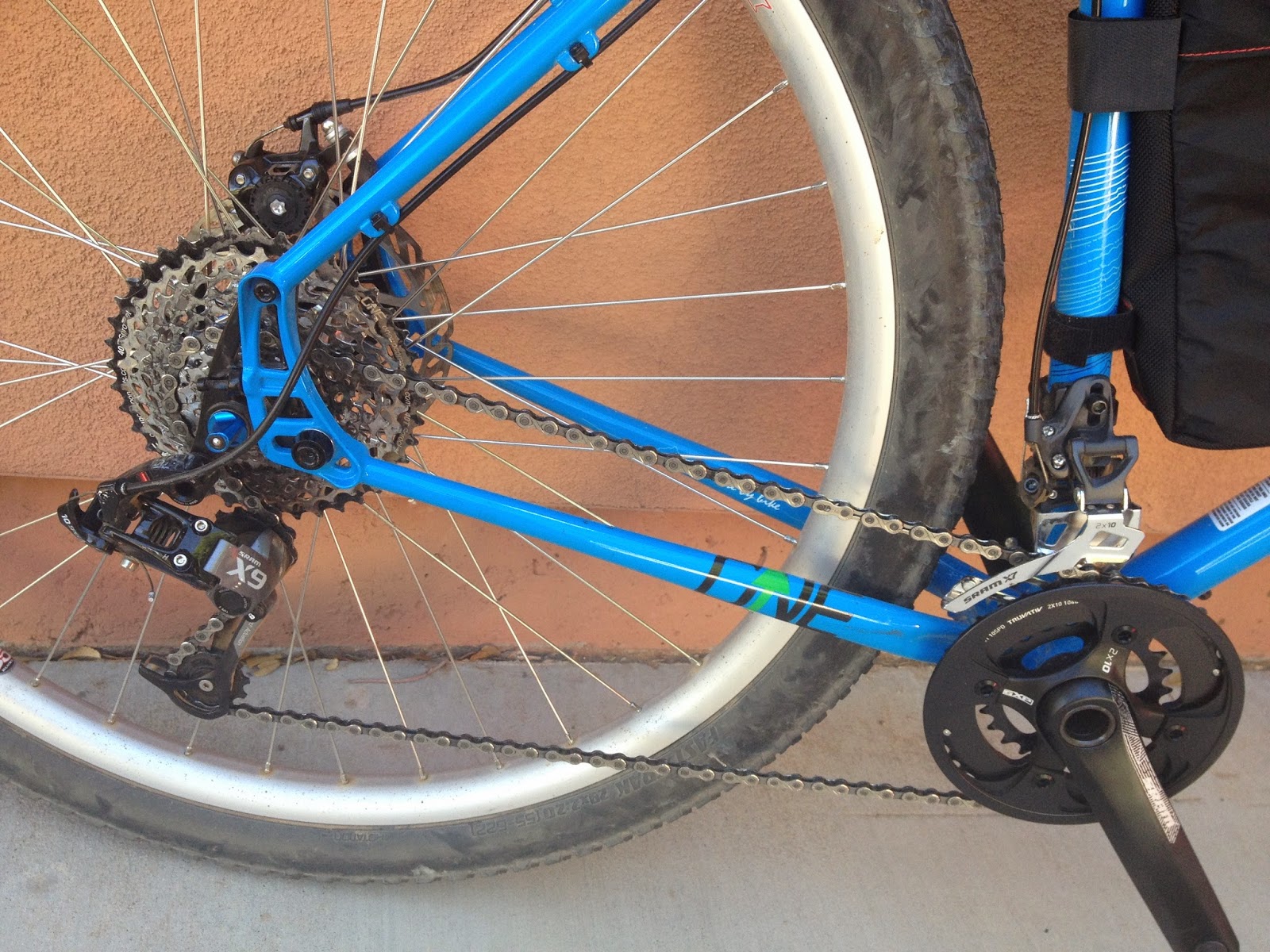
Modified wheels & drivetrain. This mule is built to climb.
Second modification: cranks.  The bike comes stock with SRAM S1000 2x crankset with 28/42 chainrings.  I want lower gearing than this, so I swapped out the stock part with a SRAM S1400 crankset (the OEM version of a SRAM X7) with 24/38 chainrings.  Thank you eBay.

Third modification: cassette.  The stock cassette is a SRAM PG1050, which I left on the stock rear.  For the custom wheel, I added a SRAM PG1070 11-36 cassette, and to that I added a OneUp 40T granny gear.  The handy thing about the OneUp kit is that comes with a 16T cog as well.  Instead of making room for the 40T cog by simply yanking one of the higher cogs - say 17T - and being left with a jump of 15T to 19T in the upper gears, you can pull out the 15T and 17T cogs, and replace them with the new 16T cog.  It does wonders to smooth out the shifting, and overall the system works as well as the stock cassette.

Now, the Tour Divide is largely about climbing, so let's talk ratios for a minute.  My Santa Cruz Tallboy has a 3x crankset with a 24T chainring up front, and a 36T cog on the back, resulting in a granny gear ratio of 24/36 = 0.667.  Decent, but I still end up walking more than I'd like on Crown King Road.  Definitely not low enough for loaded backroad touring, IMHO.  On the high end, Tallboy and Fargo both have a 42T chainring mated to a 11T cog resulting in a final drive ratio of 42/11 = 3.82.  Nice.  Now, the stock 2x Fargo crankset has a low ratio of 28/36 = 0.778 - much higher than the Tallboy, and way too high for the kind of climbing involved in the TD (again, IMHO).  Now, if I were simply to drop the front chainrings down to 22/36, that would result in a granny gear ratio of 22/36 = 0.611.  That's a significant improvement on the low end, but the penalty comes on the high end, where the final drive ratio is reduced to 36/11 = 3.27.  Not terrible, but not ideal either.  With the crank/cassette mods I listed above, my granny gear ratio is 24/40 = 0.6 (!), and the final drive ratio is 38/11 = 3.45.  Happy medium.

Why so low, you ask?  With a low ratio of 0.6, I'll probably spin out at about 5 mph, and have a comfortable cadence somewhere between 3 and 4 mph.  One could argue that I could get off the bike and push it nearly as fast as I could ride it in low gear.  Maybe, but at least with this gearing, I'm still on the bike, and I'd rather ride the bike than push it whenever I can.  Personal preference.

There are other modifications having to do with contact points, but I'll save that for another day.

It's coming together.

-David


Friday, September 19, 2014

Tour Divide 2015 - The Bike

When I was a kid, my parents allowed me a ridiculous amount of personal freedom, and I rode my bike everywhere.  On road, off road, in traffic, through fields, across town - wherever the adventure du jour was taking me.  When I got to high school, my grandmother bought me my first real road bike, a Peugeot PS20.  Chromoly frame, Shimano 600 group, all white.  A thing of beauty.  Of course, I did nothing to change the way I rode my bike, or where I rode it, and within a few months, the shape of the rims reflected my beliefs about what a bike should be. 

Ever look back on a past relationship, feel a tinge of regret, and wish you'd been a little more kind and a little less harsh?  That's how I feel about my Peugeot.  Live and learn. 

Fast forward a few years, and now I'm deciding which bike to use for the Tour Divide.  Which bike do I think is going to help me go the distance?  My overall philosophy is that generally, the fewer moving parts, the better.  Less things to go wrong.  I'm not keen on the idea of being in the middle of nowhere when a suspension seal blows out.  Plus, suspension adds a bunch of weight which I'd rather not have to pedal up all those mountains.  So, hardtail with rigid fork it is.

In a perfect world, I wouldn't have to contend with derailleurs either.  I've lost count of how many hangers I've snapped.  However, Pinion gearboxes aren't widely available here in the US, I've heard mixed reviews about Rohloff hubs on the TD, and friends, single-speeds are not for sissies.  I'm not saying I'm a sissy here, but after about a month of researching what ratio every previous TD single-speeder has used in the past, and contemplating what that would mean for ME out THERE...  Ya know what, fine, call me a sissy.  I need my gears.

So I started checking out my options.  My initial intention was to buy a naked frame & fork, and build from the ground up.  What better way to get to know your bike, right?  I put together half a dozen "virtual" bikes in the form of spreadsheets, searching for the ideal combination of frame and components.  Know what I discovered?  Building a bike from scratch is expensive.  Budget considerations eventually prevailed, and I couldn't resist the value offered in a complete bike.  But I still didn't know which one to get.

I've done enough riding on a flat bar mountain bike to know that going long distance on such a bike is very hard on my hands.  At the other extreme, there's a whole spate of drop bar cross and gravel bikes out there, but I didn't relish the idea of being hunkered down over road bars for days and days.

Salsa Fargo 2, fresh out of the box.
Thank goodness for the Salsa Fargo.  Salsa's motto is "Adventure by Bike," and in my view, no bike exemplifies this better than the Fargo. 

The Fargo is one of the go-to bikes on the Tour Divide, as it combines the best aspects of MTB and road/cross bikes into one clean, sexy package.  A more upright position than a road bike, paired with a unique shallow-drop handlebar with flared ends make this the perfect back road touring mule.  

I bought the Fargo 2, which means it has a steel frame in lieu if titanium, and some of the components are a step down from the top shelf.  Would I have preferred the Fargo TI?  Of course!  My dream bike would be a TI-frame Fargo-style 29+ bike with a Pinion 1.18 gearbox and belt drive.  How sweet would that be?  But when one has champagne tastes and a beer budget, one learns to make concessions.

Is the Fargo 2 perfect?  Few things in life are, and the Fargo is no exception.  There are two improvements at the top of my list.  First, make it belt compatible.  The bike has these nifty "Alternator" dropouts on it, but if you're running single speed or an internally geared hub, you're still stuck with a bike chain.  Lamesauce.  Second, make it 29+ compatible.  While I was waiting for my bike to arrive at my local Salsa dealer, I emailed someone at QBP to ask if it was possible to run 29+, if not front & rear, at the very least up front.  I was told that such an arrangement would "ruin" the bike's geometry.  Now that I have the bike, it's clear the Firestarter carbon fork has ample room for a 29+ tire, but there is no way to shoehorn a three inch Knard between the rear stays.  I haven't tested a 29+ tire up front, so I can't say whether or not anything would be "ruined."  But it is tempting to give it a try.

So, perfect?  No.  Awesome?  Yes!  And getting more awesomer with some choice modifications.  I'll get into those modifications in future blog posts, but suffice it to say that I wish this bike had been available when I was in high school.  Maybe then I wouldn't still feel that tinge of regret.

-David


Friday, September 12, 2014

Tour Divide 2015 - On The Weigh Down

There's a whole slew of things to consider when preparing for a multi-day bikepacking event like the Tour Divide.  First there's the stuff - the bike, the bags, the apparel, the sleeping system.  Then there's the course - maps & GPS, grades & profiles, water & resupply.  Then there's physical and mental training - making sure the body and mind are up to the task of pedaling the bike day after day after day.  It's a lot to get your hands around.

But there's one thing that often gets overlooked: weight.

I'm not talking about the weight of the bike or the weight of the gear.  Most of us obsess about that stuff.  How many of us have weighed our kit and wondered if anyone out there makes a lighter rain jacket?  Or a lighter sleeping bag?  We dream about how much weight we could save if we upgrade to a titanium frame.  Or a lighter seat post, handlebar, or derailleur.  Even now, I'm contemplating buying titanium pedal spindles so I can shave 70 grams off my rig.

70 grams.  For the love.

But what about the elephant in the room?  In all of that weight-weeny furor, it's easy to overlook the heaviest - but most important - piece of gear.  I'm talking about the weight of the rider.

Hold on, you say - does rider weight really matter?  Uh, yes it does, and it matters more than you may think.  This year's Tour de France winner Vincenzo Nibali struggled with his weight in the months leading up to the big race, so much so that his doctor speculated he would not win unless he got serious about shedding those last few pounds.  Nibali set a goal, achieved it, and won the Tour.

Now, I concede that the Tour Divide is a whole other kind of race.  But losing weight still makes a difference, whether it comes from the bike or the rider.  Some studies have shown that losing body weight may make a greater difference than shaving grams off the bike.

This is tough.  You've been living with yourself for a long time now.  So long in fact that you've come to believe you're normal.  Sure, it'd be nice to lose a few pounds, maybe even uncover that six-pack you had in high school.  "But who am I kidding" you say.  "My body is what it is."  So you focus your training efforts on building aerobic capacity and endurance, because deep down you don't really think changing your body composition by burning fat is sustainable or even possible.

Lose weight?  Like, a significant amount of weight?  Probably not gonna happen.

Are you listening to yourself?  You're about to attempt the world's toughest bike race!  If you don't think you can set a physical goal and hit it before race day, then brother, stay home.

As I write this, I'm 6'3" and about 185 lbs.  That works out to a BMI of about 23.  According to the National Institute of Health, the "healthy range" for BMI is anywhere from 18 - 25.  So I'm good, right?

Yes and no.  Yes I'm a healthy weight for life in general, but as far as I'm concerned, I'm still too heavy to sustain race pace - or even touring pace - for days on end.

That's why my goal for race day is 170 lbs.  That works out to a BMI of approximately 21.  Well within the healthy range, and not even that big a jump on the BMI scale.  But think about it - how much money would you have to shell out to drop 15 lbs off your rig?  Is that even possible?

I think it's a given that dropping weight has benefits with regard to wind resistance and the power required to pedal at speed.  However, the other significant benefit - maybe the most important one in a multi-day bikepacking event - is wear and tear on the rider.  Knees.  Ankles.  Saddle pressure.  The less body weight you carry, the longer you'll be able to stay on the bike.

Reducing body fat is part of an overall strategy for creating health for my life in general, but it is an essential ingredient when it comes to optimizing my chances for success in the Tour Divide.  Dropping weight in the weeks leading up to race day is a losing proposition, so I'm doing it now.  Achieving target weight this far out will have a positive snowball effect on subsequent training as well, allowing me to build my body and my mind with confidence as I gear up for the big day.

Can I do it?  Time will tell, but I'm confident that I can.  If you've read the "about me" sidebar of this blog, you already know I'm a health coach with Take Shape For Life.  My wife and I have had tremendous success with TSFL in the past, and are dedicating our lives to helping others transform their lives too.  I believe in TSFL because I know it works.

And it can work for you too.

So here's the pitch.  If you're gearing up for a major life event, or if you simply want to create health in your life for its own sake, contact us - we can help.  If you're reading this in September 2014, you can even join us in our Thin It To Win It Meltdown Challenge.  I can't think of a better way to kick off the fall - and head into the holidays - than making health a front burner priority.  Creating optimal health starts with burning off unnecessary fat reserves as you learn new habits of health.

Where you go from there is up to you.

-David


Wednesday, September 10, 2014

Tour Divide 2015 - Letter Of Intent

Two questions invariably come up when someone decides to take on the Tour Divide.
  1. Why (!) are you doing this?
  2. How are you gonna pull it off?
Hopefully I can answer some of the 'how' questions later on in this blog.  Maybe someone out there will find it helpful.  I'm no expert, but I've always enjoyed gleaning information and inspiration from the blogs of others as they've made their preparations.

But why?...  The question lingers.  I'm not even sure I can answer it.

I can still recall when I first learned about the Tour Divide.  It happened in 2008, but I remember it like it was last week.  The place, the noise, the light...

That summer, my wife and I were lodging in the Ronald McDonald House in Palo Alto, where our son had received a kidney transplant a couple months earlier.  It was an emotionally turbulent season for us, to say the least, and I was feeling pretty raw.  I had wandered down to the public dining room for a snack when I saw it: a beat-up copy of Outside Magazine with the audacious claim "The World's Toughest Bike Race Is Not in France" on the cover.  Being a bit of a bike nerd at heart (albeit a lapsed one), I couldn't help myself.  

Right away I was hooked.  Here they were, these young guys like Jay Petervary and Matthew Lee (along with the article's author Jon Billman) and a handful of others, and they're going to follow the Continental Divide from Canada to Mexico.  On mountain bikes.

Say whaaa?

Further, they were going to do it unsupported.  That means no chase vehicles with food or coaches or spare parts.  No fans cheering roadside.  No nutritionists, no mechanics, no massage at the end of each day.  If they wanted something during the course of the race, they had to carry it themselves, or hope they could buy it en route.

Crazy.  And irresistible.

Now at the time, I wasn't in shape to participate in a bike race around the block, let alone one over 2700 miles long.  Years at a sedentary desk job had resulted in a BMI teetering on obesity, and the cardiovascular capacity of a piano bench.  Heck, I didn't even own a mountain bike, and I could barely ride my road bike five miles without having to stop to catch my breath.  Yeah, sad.  When I thought about the Tour Divide, and the kind of shape I'd need to be in to show up at the starting line without getting funny looks - you know, the sympathetic, chuckling "what is this guy thinking?" kinda looks...  Well, the disparity between the shape I was in then and the shape I knew I'd need to be in to survive seemed insurmountable.

I believed - for me at least - that the Tour Divide was impossible.

Beliefs are powerful things.  Henry Ford said "Whether you think you can or think you can't, you are right."  Beliefs guide the decisions we make and the steps we take whether we realize it or not.  Actively or passively, we align our actions with our beliefs, and I had allowed the trajectory of my life to cement the belief in my mind that I would never be able to do something as grand and ambitious as the Tour Divide.

But I couldn't stop thinking about it.  Each year, I'd watch the blue dots on Trackleaders and listen to the racer call-ins at MTBCast, and my soul would yearn for adventure.  2010 saw the release of a movie called Ride The Divide, which provided all kinds of fodder for my adventure fantasy.  (Oh, and speaking of adventure fodder, this video by the Adventure Cycling Association is pretty awesome too.)  But at the end of the day, that's all it was for me - a fantasy.

Then in 2012, the tides of life began to change for our family.  I retired from my day job, which allowed me to start riding and training in earnest; further, our son's health continued to improve, and my wife Stacy and I were able to focus on creating health in our own lives.  We shifted from passive to active mode, and as we did, our beliefs started to change along with our bodies.  Last April, Stacy ran the Paris Marathon.  Yes, in France.  Which is a major accomplishment when you consider where she started on her journey toward health.  

Today we're in the best shape or our lives, and getting better every day.

So I'm training and gearing up.  I'm poring over maps and talking to those who have gone before.  And I'm having a blast doing it.  Next summer when I show up at the Spray River Trailhead, I might even look like I belong there.

Why am I doing this?  Because I finally believe it is possible.

Friday, January 10, 2014

Live Dangerously

"All men dream, but not equally.  Those who dream by night in the dusty recesses of their minds wake in the day to find that it was all vanity: but the dreamers of the day are dangerous men, for they may act their dreams with open eyes, to make it possible."  T.E. Lawrence, The Seven Pillars of Wisdom
People are dreamers, but too often we kid ourselves about our dreams.  We tell ourselves "If only" and "It's too big" and "I could never."  "Life is what it is," we say.  "Too late to change things now."

"It's Impossible."  With a capital "I".

But every day we don't take the path less traveled is a lost opportunity.  See, the "Impossible" is seldom actually impossible.  Usually it means "improbable" and is accompanied by the discomfort of the unknown, and the suspicion that it's going to be a lot of work to make it happen.  Challenging?  Yes.  Impossible?  No.

Take my friend Jon.  Early on, he knew he wanted to be a missionary.  He went to school, got the training, married a like-minded woman, and together they equipped themselves to follow this calling.  Then he took a pastoral position in a church, they settled in, had four kids, and began to think that the dream was over.  I mean, is it really responsible to take your kids overseas like that?  Then, while on a short-term mission trip to Bolivia, Jon met a missionary.  This man had a wife and five kids.  In Bolivia.  Jon had a heart-to-heart with his wife, and together they did some serious soul searching.  Today they're missionaries in Prague.  Czech Republic, baby!

Or my friend Luke.  He and his wife were born and raised in the USA, yet somehow they seem to have English souls.  They just spent the holidays in London.  Why?  They love the UK!  So much so that they're considering the prospect of moving there, if only temporarily.  It's too early to tell if their plans will pan out, as they still have some petty logistics to work out - things like visas and money and food and shelter.  Time will tell.  I hope they make it.

"I get a lot of email from people who say that this is their dream, but that their situation prevents them from doing it themselves.  These people are fooling themselves and wasting their opportunity.  Imagine you're 90 years old with terminal cancer.  Now would you have done it?  Because in a blink of an eye you're going to be 90 years wondering where your whole life went."  - Brad van Orden, author of Drive Nacho Drive, in an interview with Overland Journal

For some, "Impossible" might involve vast landscapes with names like Everest, or Patagonia, or heck, the moon.  For most of us, "Impossible" is likely to be a little closer to home.  Lose weight.  Run a seven-minute mile.  Travel more.  Move to a different country.  Write a book.  Go back to school.  Start a new career.  Create a new life.

For my wife and I, our "Impossible" began the day I gave my two weeks notice back in August, 2012.  Today, my lovely wife Stacy brings home the bacon while she trains for a marathon, and I homeschool our son, and get to ride my bike pretty much whenever I want.

"This row across the Atlantic Ocean will create memories that you will take to your grave.  The dolphins, the sharks, the storms, the struggles - it's all priceless.  Your years of work will all blur into one another.  But this year won't.  Believe me, forty years down the road, you're not going to kick yourself for having rowed across an ocean."  - Julie Angus, author of Rowboat In A Hurricane

As our life unfolds, what used to appear to be "impossible" has become our "normal."  Then a funny thing starts to happen.  New dreams arise, new goals appear on the horizon.  Ultra-marathon?  Tour Divide?

Impossible?  Time will tell.

In the mean time, we live a life with no regrets.

What's your "Impossible" dream?  Live dangerously.

Sunday, July 28, 2013

Does This BMI Chart Make Me Look Fat?

I was checking out the BMI tables on the National Institute of Health website recently (nerd alert).  For a lot of years, I thought the whole BMI thing was bunk, mainly because it kept telling me I was overweight.   These days when I talk to folks about the connection between health and weight, I often encounter a familiar resistance.  "It doesn't apply to me because I have a muscular build" or "I have big bones" or "I'm husky" or "those charts are crap."

Hey, I've been there.

Now that I have a 'normal' BMI (per the NIH), I've come to realize that the BMI tables are not crap.  But first let's look at how the NIH defines "overweight," and "obese."  The NIH website says "Overweight is having extra body weight from muscle, bone, fat, or water.  Obesity is having a high amount of extra body fat."  Interesting, but what does this mean?  It means that the NIH has already accounted for muscular builds and big bones.

Certainly there are exceptions: the BMI chart doesn't apply to Arnold Schwarzenegger or Dwayne 'The Rock' Johnson.  Indeed, the NIH states that the BMI chart "... may overestimate body fat in athletes and others who have a muscular build."  Conversely, "It may underestimate body fat in older persons and others who have lost muscle."  But I'm not Arnold, and chances are, if you're using performance enhancing substances to shed & shred, you're probably not reading this blog anyway.

But how athletic can someone be before he trips into the obese column?  To find out, I toodled on over to the CrossFit Games website, and had a look at the leaderboard.  Have you seen these people?  Lean.  Cut.  Probably the fittest humans on the planet.  How do they stack up on the BMI chart?  Of the top ten men on the leaderboard, most had a BMI in the 25-30 range; only one had a BMI over 30.  Women trended even lower.

So what does that mean for you and me?  It means that if you have a BMI of 30 or more, you're carrying too much fat, period.  And if you have a BMI of 25 - 29.9, you're probably still carrying too much fat.  Unless of course you're competing in the CrossFit Games.  Then you're probably okay.

Big deal, you think.  What difference does a little extra fat really make anyway?  I'm healthy, right?

For now, maybe you're right.  But what about later on?  What quality of life to you want to have later in life?  How do you want to live in ten years?  In twenty?  In fifty?

The NIH answers the question Why Is A Healthy Weight Important?  "Reaching and maintaining a healthy weight is important for overall health and can help you prevent and control many diseases and conditions.  If you are overweight or obese, you are at higher rise of developing serious health problems, including heart disease, high blood pressure, type 2 diabetes, gallstones, breathing problems, and certain cancers.  That is why maintaining a healthy weight is so important: It helps you lower your risk for developing these problems, helps you feel good about yourself, and gives you more energy to enjoy life."

Why should you pay attention to the BMI tables?  Your future depends on it.  Your doctor and your insurance underwriter use it when they assess you.  You should too.

Be honest with yourself.

Use the BMI calculator.  Find out where you are.  Figure out where you want to be.

Now do something about it.

You are the dominant force in your own life when it comes to creating health.  No one is going to do it for you.  "My doctor will save me" you think.  But your doctor can't do any more than manage symptoms as they appear.  There is no magic bullet.  The little daily choices you make today will do more for your health, now and in the future, than anything your doctor can prescribe.  Ever.

Not sure where to turn?  Join me!  My wife and I are FREE Certified Health Coaches with Take Shape For Life.  We can help you quickly and safely attain a healthy weight, and learn the habits necessary to maintain it for the rest of your life.  Contact us and let's create health in your life too!

DavidJamesPhillips@Gmail.com

Wednesday, July 24, 2013

Moving Mountains

I watched a TED talk this morning by Philippe Petit, the high-wire walker featured in the 2008 documentary Man On Wire.  Petit is an expert story teller, and in less than twenty minutes gives a riveting synopsis of a life of beating the impossible.  My favorite line comes right at the end, when he says -

"When you see mountains, remember - they can be moved."

How often does losing weight and "getting healthy" seem impossible?  I can't remember how many times I tried and failed to make lasting changes in my life with regard to health and weight.  That is until I discovered Take Shape For Life.

Take Shape For Life is not a diet.  It is a way of overhauling your way of life.  See, I knew that my way of life had created a problem that needed fixing, and that another diet was not the solution.  By forging new habits, I've been able to reorient my way of life toward optimal health and longevity.

In other words, mountains have been moved.

Has your way of life created a weight problem you need to address?  Have you tried and failed to lose weight and keep it off?  Is your weight causing other problems with your health?  Do you have mountains you'd like to move?

I am a FREE Health Coach with Take Shape For Life, and if you're coachable, I can help.  Contact me, and let's reorient your way of life toward optimal health and longevity.

Be inspired, and never forget that mountains can be moved.

DavidJamesPhillips@Gmail.com

Sunday, July 21, 2013

Corrections Of Course

Continuing with the whole explorer/navigator theme, consider what may have become of Cortez or Columbus if they had been off by a few degrees when they embarked on their voyages?  When sailing, one is constantly checking and re-checking the ship's heading, making course corrections all along the way.  Where might they have ended up if they had gotten lazy or sloppy?  What would the world map look like today if Columbus landed in Newfoundland or Brazil instead of the Bahamas?  Our world might be a different place.

Sometimes it's difficult to tell what kind of progress we're making with regard to weight loss and health.  I know in my own life there have been many times where I've hit a plateau, or even gone up a pound or two (or five), and I start to ask questions: "So what?  Is it really that important?  I don't feel all that different - it's not like I'm sick or anything.  Does it really matter how much I weigh?"

At moments like these, I need to make a mental course correction and reorient myself toward health.  Because YES, it matters!

Dr. A says:
"In a state of non-sickness, time is against you.  It may go unnoticed until one day you're so fatigued that you finally go to your doctor and find out you have diabetes.  Your health path has led you from non-sick to sick...  The good news is that the non-sick can usually reach optimal health in a relatively short amount of time." -Dr. A's Habits of Health, p. 12
Mental course corrections, made repeatedly over time, result in physical course corrections: every pound lost, every inch of body measurement, every dress size - each of these is a degree of physical course correction that may seem trivial now, but is going to pay off big time later on in life (even now, your body is thanking you as inflammation subsides, blood pressure reduces, insulin stabilizes, and pressure on joints starts to lift).

Sometimes you're just a degree off your heading, and the course correction is a minor one; sometimes you've let yourself drift, and have to do a 180.  In any case, these course corrections - made daily if necessary - are what will ensure you maintain your heading toward optimal health.

What's your bearing?  Where's your head at?  How's your body?  Are you healthy, sick, or somewhere in between?  Are you pointed in the right direction?  That all depends on your goals I suppose, but if your goals include things like health and longevity, then the direction you're headed today makes all the difference in the world.

The journey is long, and is bound to pass through troubled waters, unexpected storms, and for many, uncharted territory.  Check your heading, and correct your course.  Someday soon, you'll discover a new world of optimal health.

Want to orient yourself toward optimal health but not sure where to turn?  I am a FREE Certified Health Coach with Take Shape For Life, and I can help you find your way!  Contact me, and let's get you headed in the right direction.

DavidJamesPhillips@Gmail.com

Friday, July 19, 2013

A Line In The Sand

When starting out on the journey to lose weight and create health, one of the first things we ought to do is take a "before" picture.  As in, "this was me before I started losing weight."  Yet a lot of folks don't want to do it.  Why is that?

Okay, I'll be the first to admit: it's not fun standing in front of a camera when you're thick.  It just isn't.  I can't remember how many times I plastered on a smile and said Cheese! for the camera when I was overweight.  And that was at family functions and other events where the photo was pretty much an obligation.  I would do all I could to make myself look small.  "If I crane my neck and hold this angle, maybe the camera won't pick up my multi-chin" or "I'll just hide behind so-and-so, so nobody can see the gut."  Easy to do when you're 6'3".  You shorties out there have my sympathy.

But actually posing for a picture, the purpose of which is to accurately expose one's present physical condition?  Yikes!

It is critical that you do this.

I can't emphasize this enough.  The photo marks the pivot point in your life, the moment when everything changed.  You're saying, if only to yourself, "I am committing to this process, I am going to make this life change, I am going on this journey, and THIS is where I started."  It marks the day you drew a line in the sand.

Then, if you're feeling brave, post it up on your home page, and make that commitment public.  Scary?  Heck yeah!  But you will be amazed at the outpouring of support, sometimes from complete strangers, as you venture forth.

Someday you'll look at that picture and remember "Yup, that was me.  That's where I came from.  That's where I started.  And I am never going back there again."

"Those who cannot remember the past, are condemned to repeat it." -George Santayana, philosopher

If you've been longing to lose weight and get healthy, but don't know where to start, I can help.  I am a FREE Certified Health Coach with Take Shape For Life, and my mission is to help people create health in their lives.  Find out more here, or email me directly at DavidJamesPhillips@Gmail.com.

Tuesday, July 16, 2013

Reflections of Grit

Grit (noun): the tendency to work strenuously toward challenges, maintaining effort and interest over years despite failure, adversity, and plateaus in progress. (Charles Duhigg, The Power of Habit).

Most of us think we have grit.  Certainly we can recognize its value when it comes to the pursuit of personal accomplishments and, well, anything else worth having.

Career.  Relationships.  Health.

But once in a while it's good to look outside of ourselves to see what Grit looks like from someone else's perspective.

Enter Peter Kraft Sr. (age 50) and Peter Kraft Jr. (age 20), from Gainesville, FL.  This father & son team just finished the Tour Divide, but not before it nearly finished them.

The Tour Divide is a grassroots mountain bike race tour that begins in Banff, Canada, and follows the continental divide to the Mexican border.  2700+ miles, and over 200,000 feet in elevation (i.e. climbing).  Anyone who finishes this non-race has some considerable measure of grit.

This year's event began on June 14th.  The guy who finished first, Mike Hall, did it in less than 15 days.

Grit.

Forest Baker and Eric Foster are going for the so-called triple crown of endurance mountain biking: having already completed the Arizona Trail Race in April, they've finished the Tour Divide, and are now headed to the starting line of the Colorado Trail Race, which starts on July 21st.

Double serving of Grit.

Peter Kraft Sr. & Jr?  They rolled up to the Mexican border last night around 9 p.m., 31 days after they left Banff.  Not exactly a course record.

Grit?

Consider that these two have been preparing for this event for three years.  Anyone who makes it to the starting line deserves a medal, and these two lined up in Banff with the rest of the pack.  Then they rode for 2000+ miles to New Mexico, where disaster struck.  First, Kraft Sr. crashed.  Kraft Jr. accompanies Sr. in the ambulance for the hour-plus ride to the hospital, where Sr. is stitched back up.  Then, they hitch a ride back to the course, get back on the bikes, and they KEEP GOING.  Then, Kraft Jr. gets violently ill.  Throwing-up-all-night ill.  In the middle of nowhere.  They find a park ranger, who assesses the damage and tells them they're in trouble.  Another ambulance ride to another hospital.

At this point, I'm almost hoping they throw in the towel.  "It's been a heck of a ride boys.  You've earned your battle scars.  Now go on home and lick your wounds."

Do they quit?  Nope.

Jr. recovers.

     The go back to the course.

          They get back on the bikes.

              And they finish the race.

Grit?

Off the charts.  They ought to make a movie about these two.

Well done Krafts.  Whenever I think about bailing on, well, anything, I'm gonna remember the name Kraft, and think again.

-David

Monday, July 15, 2013

My Dinghy's On Fire!

When Cortez reached the new world, he burned his ships to ensure he and his crew could not go back the way they came.  Onward!

I burned a little ship of my own the other day.  Okay, maybe not a "ship" per se - more like a dinghy.

We just returned home from family vacation in Carlsbad, our annual week at the beach.  It was bliss.  However, vacations can pose a challenge when it comes to making productive eating decisions.  Different sights, different people, different kitchen.  All of these "differents" can throw the routine off, if you know what I mean.  Let's just say not all my decisions were productive ones in light of my health goals.  Nothing major, but enough to make me start to question my ability to maintain for the long term.

When we returned home, I was reminded of where I was a couple years ago.  As I unpacked, I found my old swimming trunks tucked away in a drawer.  My "big daddy" trunks.


For years, I've had two pairs of swimming trunks: my "fit daddy" goal trunks, and my "big daddy" trunks.  In the past, I'd take both pairs on vacation, hoping against hope that I could get the fit daddy trunks up past my rump.  I would try, then abandon the effort, break out the big daddy's, sigh as I slipped them on, then pretend I wasn't embarrassed to go outside without a shirt.

Yup, there they are.  Don't melt your retinas.

Last year was the first year I was actually able to get the "fit daddy" trunks on.  This year, I didn't even pack the "big daddy" trunks.  When we got home, there they were.

See, I've kept them around, just in case.  Just in case it all goes to pot.  Just in case I throw it all away and blow up again.  Just in case I get selfish and lazy again, and decide that instant gratification is more important than fitness and longevity.

I cut them in half and threw them in the trash.  Just like that.  Because there will not be a "just in case."  There will not be a next time.  I burned my dinghy.  Because--

I.  Am.  Not.  Going.  Back.

Arguably, shredding a pair of shorts may be a small milestone to some (I've seen my formidable wife Stacy dispose of yard-bags filled with old "big girl" clothes).  But it was a big deal to me.

Onward!

Do you have a ship you wish you could burn?  Any "big boy" clothes you wish you could give away?  I can help!  I am a Certified Health Coach with Take Shape For Life, and I can help you achieve your health goals.  Hey, life is too short to pretend to not be embarrassed at the beach.  Join me, and let's move forward together.

DavidJamesPhillips@Gmail.com

Tuesday, July 9, 2013

If We Don't Change Anything, Nothing Changes

People say change is hard.  But the hardest part of change is not the change itself, but recognizing that it’s necessary.  Somehow, we need to realize that we’re oblivious or in denial about certain aspects of our lives, and acknowledge that we alone are responsible to actually do something about it.

Outside Magazine recently published an article titled "YOU'RE DELUSIONAL ABOUT YOUR HEALTH."  Subtle, but it hits close to home. 

I was at a conference during my "thick" years, and one of the attendees and I sported remarkably similar hairstyles.  Naturally I thought I rocked it and that he didn't, in particular because I viewed him as "thick" and myself as, well, less thick.  Fine, I viewed myself as svelte, and gloated to myself about how lean & mean I looked.  A month later I received the quarterly newsletter from the conference sponsor, and there on the cover was a photo of me and the other similarly coiffed dude.  And we looked the same.  Same hair, same gut, same chins (yes, more than one each).  The.  Same.  If anything, I was the thick one.  Talk about deluded.

We train ourselves to see our bodies in a certain way.  We think, “Oh, I’m not that thick.”  Really?  Then we catch ourselves off guard and get a glimpse of the truth.  Ever been tagged in a candid photo on Facebook and not recognize yourself?  Ever catch a reflection in a window or a mirror as you round a corner at the mall?  Who is that person?

We become desensitized to our own condition.  Like the “cat lady” who lives alone because she can no longer smell the dozen-plus felines that keep her company, we become desensitized to our physical condition.  We simply get used to it. 

Admitting we have a problem is the first step to recovery, right?

So let’s say you have a vague notion of the truth about yourself, but you don’t really know what to do.  How does one create health?  For a long time after my delusion shattered, I had no clue.  All I knew was that something had to change.  I just didn’t know what, or how, or… anything.  So for a long time, I did nothing.

And you know what I found?  If you don’t change anything, nothing changes.  Hoping and wishing and pining and dreaming for change doesn’t get the job done.  It’s not until we actually do something about the problem that things stand a chance of turning around. 

So if you want optimal health in your life but you don't know how to create it, chances are you're probably not doing anything intentional about it.  Hey, there’s good news: you’ve already nailed the hard part, realizing the need to change. 

If all you lack is the tools, then I’m your guy.  I have been where you are now, and I’m telling you it’s possible.  Once we have the tools to make the change, the change itself is not that difficult.  I’m a Health Coach with Take Shape For Life, and I can help.  Contact me, and let’s make the change.


“It's never too late to be what you might have been.”  –George Elliot.

DavidJamesPhillips@Gmail.com