Showing posts with label SRAM. Show all posts

Wednesday, January 28, 2015

Squeaks & Creaks

So I have a creak in the bottom bracket (SRAM GXP) on my Salsa Fargo. Spent much of yesterday trying to eliminate it without success. By day's end, I had replaced the old BB with a new one, but only after removing/reinstalling, cleaning and re-packing the original BB several times. Also torqued the spider and chainring bolts to spec and re-greased the crank spindle where the arm bolts on. 

By bedtime, it was still squeaking. If anything, it was getting worse. Grr.
What could it be? Did some Googling. Pedals? Derailleur hanger(s)? Thud-buster seat post? Alternator dropouts? My money's on the dropouts. Folks have had all kinds of issues with them, and have tried all kinds of remedies to, well, remedy those issues.

Woke up this morning prepared to wage greasy war on all bolts and slider plates anywhere on the back half of the bike.

But first, I decided to swap out the custom wheel for the factory wheel and test it out. 'Cause I mean, what if it's the rear hub on my spendy custom wheel? So I swapped wheels and went for a spin.  

No creak.

Oh darn. (Or something like that.) Must be the hub, right? So not looking forward to breaking down and rebuilding my Hadley.

So I sigh, take the factory wheel back off, sigh again, put the custom back on, and flip the skewer shut. Hmm, seems a little loose. Undo, cinch it up tight, and lever it shut. Just for grins, I take it out.

Guess what. No creaking.

So, the creak appears to have been coming from the rear dropout, because maybe the QR wiggled loose over the past month? It's been about that long since the rear wheel has been off the bike. Hoping the creak stays gone. So far, so good.

Sometimes it's the little things.


Friday, September 26, 2014

Tour Divide 2015 - Bike Mods

So, Salsa Fargo 2.  Steel frame, drop bars.  A great bike.  How do I make it better?  More specifically, how am I going to tailor this bike for my use as an overland back country survival vehicle?  The Tour Divide takes place mainly on backroads and trails, with a little bit of single-track and a whole lot of climbing.  So what about this bike needs to change?

First modification: wheels.  There's a growing body of evidence that suggests that for mountain biking, wider rims make more sense than the beefed up narrow rims found on most mountain bikes today.  Less burping, better float, less deformation, reduced rolling resistance, yada yada yada.  All very controversial and subject to personal preference, but it makes sense to me.  So I had Peter White build up a new set of wheels using Velocity Blunt 35's drilled to fit a Schrader valve.  Why Schrader?  How many back country gas stations have a compressor with a Presta tire filler?  That's right - zero.  Rear hub is a Hadley 135mm QR, and up front I'm running a Schmidt SON 28 15, a dynamo hub that outputs 6W at 9mph - enough to run a headlight and keep my phone charged.  Wheels are set up for tubeless, and I'm running Specialized Fast Trak Control 29x2.2" tires.  They're light, they're fast and they're quiet, even on pavement.  I love my wheels.

What about the stock wheels?  I set them up with Schwalbe Marathon HS 420s.  I've taken them out a few times, but they're less comfortable and no faster than the Fast Traks, so I leave them at home and use them on the trainer.

By the way, cost of a complete bike plus custom wheels was about the same as the cost of a naked frame & fork set built up from scratch.  This way, though, I have a second set of wheels to train with.  Food for thought. 

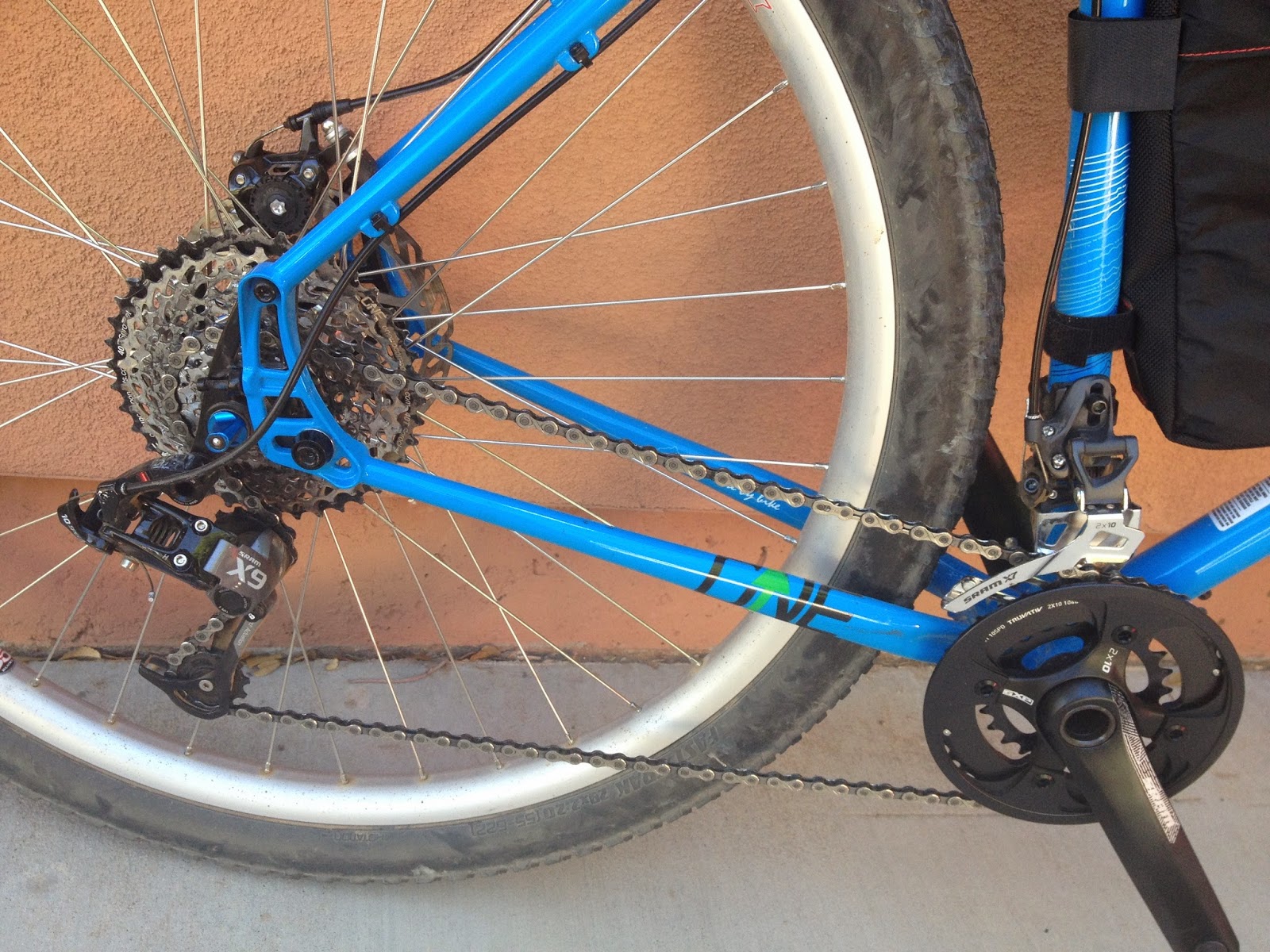
Modified wheels & drivetrain. This mule is built to climb.
Second modification: cranks.  The bike comes stock with SRAM S1000 2x crankset with 28/42 chainrings.  I want lower gearing than this, so I swapped out the stock part with a SRAM S1400 crankset (the OEM version of a SRAM X7) with 24/38 chainrings.  Thank you eBay.

Third modification: cassette.  The stock cassette is a SRAM PG1050, which I left on the stock rear.  For the custom wheel, I added a SRAM PG1070 11-36 cassette, and to that I added a OneUp 40T granny gear.  The handy thing about the OneUp kit is that comes with a 16T cog as well.  Instead of making room for the 40T cog by simply yanking one of the higher cogs - say 17T - and being left with a jump of 15T to 19T in the upper gears, you can pull out the 15T and 17T cogs, and replace them with the new 16T cog.  It does wonders to smooth out the shifting, and overall the system works as well as the stock cassette.

Now, the Tour Divide is largely about climbing, so let's talk ratios for a minute.  My Santa Cruz Tallboy has a 3x crankset with a 24T chainring up front, and a 36T cog on the back, resulting in a granny gear ratio of 24/36 = 0.667.  Decent, but I still end up walking more than I'd like on Crown King Road.  Definitely not low enough for loaded backroad touring, IMHO.  On the high end, Tallboy and Fargo both have a 42T chainring mated to a 11T cog resulting in a final drive ratio of 42/11 = 3.82.  Nice.  Now, the stock 2x Fargo crankset has a low ratio of 28/36 = 0.778 - much higher than the Tallboy, and way too high for the kind of climbing involved in the TD (again, IMHO).  Now, if I were simply to drop the front chainrings down to 22/36, that would result in a granny gear ratio of 22/36 = 0.611.  That's a significant improvement on the low end, but the penalty comes on the high end, where the final drive ratio is reduced to 36/11 = 3.27.  Not terrible, but not ideal either.  With the crank/cassette mods I listed above, my granny gear ratio is 24/40 = 0.6 (!), and the final drive ratio is 38/11 = 3.45.  Happy medium.

Why so low, you ask?  With a low ratio of 0.6, I'll probably spin out at about 5 mph, and have a comfortable cadence somewhere between 3 and 4 mph.  One could argue that I could get off the bike and push it nearly as fast as I could ride it in low gear.  Maybe, but at least with this gearing, I'm still on the bike, and I'd rather ride the bike than push it whenever I can.  Personal preference.

There are other modifications having to do with contact points, but I'll save that for another day.

It's coming together.

-David


Friday, September 19, 2014

Tour Divide 2015 - The Bike

When I was a kid, my parents allowed me a ridiculous amount of personal freedom, and I rode my bike everywhere.  On road, off road, in traffic, through fields, across town - wherever the adventure du jour was taking me.  When I got to high school, my grandmother bought me my first real road bike, a Peugeot PS20.  Chromoly frame, Shimano 600 group, all white.  A thing of beauty.  Of course, I did nothing to change the way I rode my bike, or where I rode it, and within a few months, the shape of the rims reflected my beliefs about what a bike should be. 

Ever look back on a past relationship, feel a tinge of regret, and wish you'd been a little more kind and a little less harsh?  That's how I feel about my Peugeot.  Live and learn. 

Fast forward a few years, and now I'm deciding which bike to use for the Tour Divide.  Which bike do I think is going to help me go the distance?  My overall philosophy is that generally, the fewer moving parts, the better.  Less things to go wrong.  I'm not keen on the idea of being in the middle of nowhere when a suspension seal blows out.  Plus, suspension adds a bunch of weight which I'd rather not have to pedal up all those mountains.  So, hardtail with rigid fork it is.

In a perfect world, I wouldn't have to contend with derailleurs either.  I've lost count of how many hangers I've snapped.  However, Pinion gearboxes aren't widely available here in the US, I've heard mixed reviews about Rohloff hubs on the TD, and friends, single-speeds are not for sissies.  I'm not saying I'm a sissy here, but after about a month of researching what ratio every previous TD single-speeder has used in the past, and contemplating what that would mean for ME out THERE...  Ya know what, fine, call me a sissy.  I need my gears.

So I started checking out my options.  My initial intention was to buy a naked frame & fork, and build from the ground up.  What better way to get to know your bike, right?  I put together half a dozen "virtual" bikes in the form of spreadsheets, searching for the ideal combination of frame and components.  Know what I discovered?  Building a bike from scratch is expensive.  Budget considerations eventually prevailed, and I couldn't resist the value offered in a complete bike.  But I still didn't know which one to get.

I've done enough riding on a flat bar mountain bike to know that going long distance on such a bike is very hard on my hands.  At the other extreme, there's a whole spate of drop bar cross and gravel bikes out there, but I didn't relish the idea of being hunkered down over road bars for days and days.

Salsa Fargo 2, fresh out of the box.
Thank goodness for the Salsa Fargo.  Salsa's motto is "Adventure by Bike," and in my view, no bike exemplifies this better than the Fargo. 

The Fargo is one of the go-to bikes on the Tour Divide, as it combines the best aspects of MTB and road/cross bikes into one clean, sexy package.  A more upright position than a road bike, paired with a unique shallow-drop handlebar with flared ends make this the perfect back road touring mule.  

I bought the Fargo 2, which means it has a steel frame in lieu if titanium, and some of the components are a step down from the top shelf.  Would I have preferred the Fargo TI?  Of course!  My dream bike would be a TI-frame Fargo-style 29+ bike with a Pinion 1.18 gearbox and belt drive.  How sweet would that be?  But when one has champagne tastes and a beer budget, one learns to make concessions.

Is the Fargo 2 perfect?  Few things in life are, and the Fargo is no exception.  There are two improvements at the top of my list.  First, make it belt compatible.  The bike has these nifty "Alternator" dropouts on it, but if you're running single speed or an internally geared hub, you're still stuck with a bike chain.  Lamesauce.  Second, make it 29+ compatible.  While I was waiting for my bike to arrive at my local Salsa dealer, I emailed someone at QBP to ask if it was possible to run 29+, if not front & rear, at the very least up front.  I was told that such an arrangement would "ruin" the bike's geometry.  Now that I have the bike, it's clear the Firestarter carbon fork has ample room for a 29+ tire, but there is no way to shoehorn a three inch Knard between the rear stays.  I haven't tested a 29+ tire up front, so I can't say whether or not anything would be "ruined."  But it is tempting to give it a try.

So, perfect?  No.  Awesome?  Yes!  And getting more awesomer with some choice modifications.  I'll get into those modifications in future blog posts, but suffice it to say that I wish this bike had been available when I was in high school.  Maybe then I wouldn't still feel that tinge of regret.

-David