Showing posts with label cycling. Show all posts

Monday, July 18, 2016

2016 Tour Divide Recap

"Everyone has a plan 'til they get punched in the mouth." -Mike Tyson

I thought I was ready.

I thought I had trained well. I thought I was well equipped, well provisioned. I thought I had it all planned out, with resupply stops and mileage goals for a 21-day finish all mapped out. 

I thought wrong.

Pre-Race


I flew to Calgary where I have family who picked me up at the airport, fed me, put me up, and drove me to Banff the day before the race. They, like myself, are bike nerds, and have every imaginable bike tool in their garage, so it was the perfect place to open the bike box and build the beast. So far so good. I checked into the Y, caught the tail end of Crazy Larry's pre-race Q&A, and caught up with Josh Waters, who had introduced himself at the airport in Phoenix. Quality man. We walked over to Atmosphere to procure bear spray (Pro tip: tell them Crazy Larry sent you - they just might give you a discount.), then headed back to the Y. As I prepared my bike bags and checked my kit, I discovered that my down jacket was missing. I called my wife, who confirmed that my down jacket - which I had purchased for this race - was indeed hanging safely in my closet. Sigh. With the forecast calling for rain and misery, I didn't want to leave Banff without one. What to do?


Day 1 Plan: Banff to Sparwood (+/- mile 140)


Day 1 Reality: Banff to Boulton Creek Trading Post (+/- mile 60). 


Race day, and I still needed a down jacket. So I stood with the crowd for the group photo, rolled out to the trailhead en masse, waited for everyone to go through, then headed back into town. Shops opened at 10:00, so by the time I found a suitable replacement and got my act together, it was 11:00 before I was on course. By that time it was raining, and it continued to rain the whole day. With the late start, I figured I'd only make it to Elkford before dark. However, when I arrived at Boulton Creek Trading Post eight hours later, I couldn't stop shivering, even after a microwave sandwich and a cuppa hot chocolate. Frustrated and freezing, I decided to call it a day, and headed down to the Lower Lakes Campground for the night. (Pro tip: When it starts to rain, bust out the rain gear. I passed a lot of people who waited too long to stop; by the time they put their rain gear on, they were soaked through and at risk of hypothermia. Conversely, when it stops raining, shed the rain gear as soon as you can, before you wet through from the inside.) I pitched my tent in the drizzling rain and crawled into my sleeping bag. Sleep would prove elusive, however. It'd been a while since I'd been honest-to-goodness tent-camping, and I had the hardest time falling asleep. This would prove to be a recurring problem: Most nights, I just lay there with my eyes closed, wishing for sleep that would not come.

In the back of my mind I knew I had fallen well short of my goal - barely half way to Elkfork? Less than half way to Sparwood?! - but I stuffed those thoughts down deep and rationalized my decision to call it a day. I'm managing expectations, I told myself. But I was also faintly aware that I was at risk of setting the tone for the rest of the tour, of settling for lower mileage when things got tough. I stuffed those thoughts too.

Highlight: John, one of the other riders I encountered at Boulton, decided he'd had enough too, and we rode together to the Lower Lakes campground. As we meandered down the drive to the campground, I saw a sign on the right side of the road that explained the campsite registration procedure. Not wanting to stop, I focused on the sign as I zipped past, only vaguely aware of the open field on the opposite side of the road. When I got to the bottom of the drive, John was no longer behind me. Where did he go? A minute later he appeared, coasting down to where I had stopped. "I thought I lost you," I called out. "I was watching the grizzly bear!" he responded. Apparently as I was was focused on the sign, a griz in the field on the opposite side of the road was focused on me. I had no idea. The campground steward came to check on us as we pitched camp, and John asked about the bear. "Don't worry about the bear!" he reassured us. A few minutes later, we heard bear bangers cracking in the distance as the steward ran Mr. Griz off. We had no further run-ins, so I can only assume the steward was successful. And that was as close as I ever came to a bear sighting.


Day 2 Plan: Sparwood to Eureka (+/- mile 260)


Day 2 Reality: Boulton Creek to Sparwood (+/- mile 140)


I woke up soaking wet (it rained through the night), broke camp and hit the trail. Everything was soaked. The day started cold and windy, then warm and sunny, then cold and windy again, sometimes all within a few minutes. I saw no bears, but I did spot a moose (huge animal - no rack, but unmistakable in profile) along the climb to Elk Pass. It took its sweet time eyeing me before lumbering off into the bush, and I thought it best to let it have its way. I stopped in Elkford to resupply and spray the muck off the bike (The owner at FasGas actually drove to the store and brought the hose out of the backroom for me. Talk about service!). I baked in the sunlight on the climb out of Elkford, then froze in the wind on the descent into Sparwood. Even though it was early (not yet 7 p.m. according to Trackleaders), I decided to call it a night at the hotel. I went shopping for resupply, ordered pizza (Funky!), then pitched my tent in the room (it was wet through) and hung up my soggy clothes, hoping everything would be dry by morning.

Wait, Sparwood? By now I'd lost an entire day, but the allure of a warm, dry hotel room, and the prospect of actual food drew me in. Besides, bear country. No matter, I thought- you're just a day off your original plan. Just kick it into gear tomorrow, and make up some distance. Or settle for a 22 day finish. You got this.

Highlight: Around mile 70 there's a BC Forest Service Recreation Site, which includes a cabin with cots and woodstove. First come first served. This place is in the middle of nowhere - except that it's listed on the ACA Canada map and is right on the trail. Well, a local nature lover (Rob was his name) decided to drive to the middle of nowhere for a weekend of solitude. He arrived at the cabin on Thursday June 9th. On Friday, about mid-morning, the Tour Divide peleton started pouring through, many of them stopping to warm up and dry out. Half a dozen riders even crashed his party and camped in (or near) the cabin that night. By the time I stopped at the cabin on Saturday morning to dry out, Rob's patience was wearing thin. He was kind, but you could tell he was not having the peace and quiet he had hoped to find that weekend. Thanks for being a good sport Rob.


Day 3 Plan: Eureka to Bigfork (+/- mile 400)


Day 3 Reality: Sparwood to Wigwam (+/- mile 230)


I woke up to discover that although my tent had aired out, my clothes were not dry. None of them. I took my bundle of damp kit downstairs and asked if I could throw it in the dryer, only to be told that it was against hotel policy. On the way back to the room, I commandeered a luggage cart, hung all my stuff from the top bar, parked the whole mess in front of the heater, and cranked it all the way up. Half an hour later, I could at least get my clothes on. Late start - out the door by 7:15. Easy rolling start with miles of pavement. I broke the headlamp mount off my fork while hoisting my bike over the Jersey barrier to get onto Corbin road. (Pro tip: Bring extra zip-ties! Also, the Google Maps satellite images are out of date and the GPS track is misleading, but I'm guessing there's probably a legit entrance from the highway onto Corbin Road a little further east.) By the time I got to Corbin, TD riders Rick May and Ian Ford had caught up with me. We leap-frogged our way over Flathead pass, taking turns leading down the rocky (!) descent and through the water crossings. (Pro tip: Keep your hubs and bottom bracket out of the water, or risk having to replace your bearings down the road.) By the time I made it to Butts Cabin, Rick and Ian had left me behind. The weather was perfect, and I had a spectacular grind up Cabin Pass, followed by a lively descent down to the Wigwam Recreation Site. Rick and Ian were there already, considering their options - do we stay or do we go? Rick, who had toured the route three times previously, knew what was to come (Wall + Galton), and recommended staying for the night. As the sun appeared to be setting, it was not a hard sell. We pitched camp, and hit the sack.
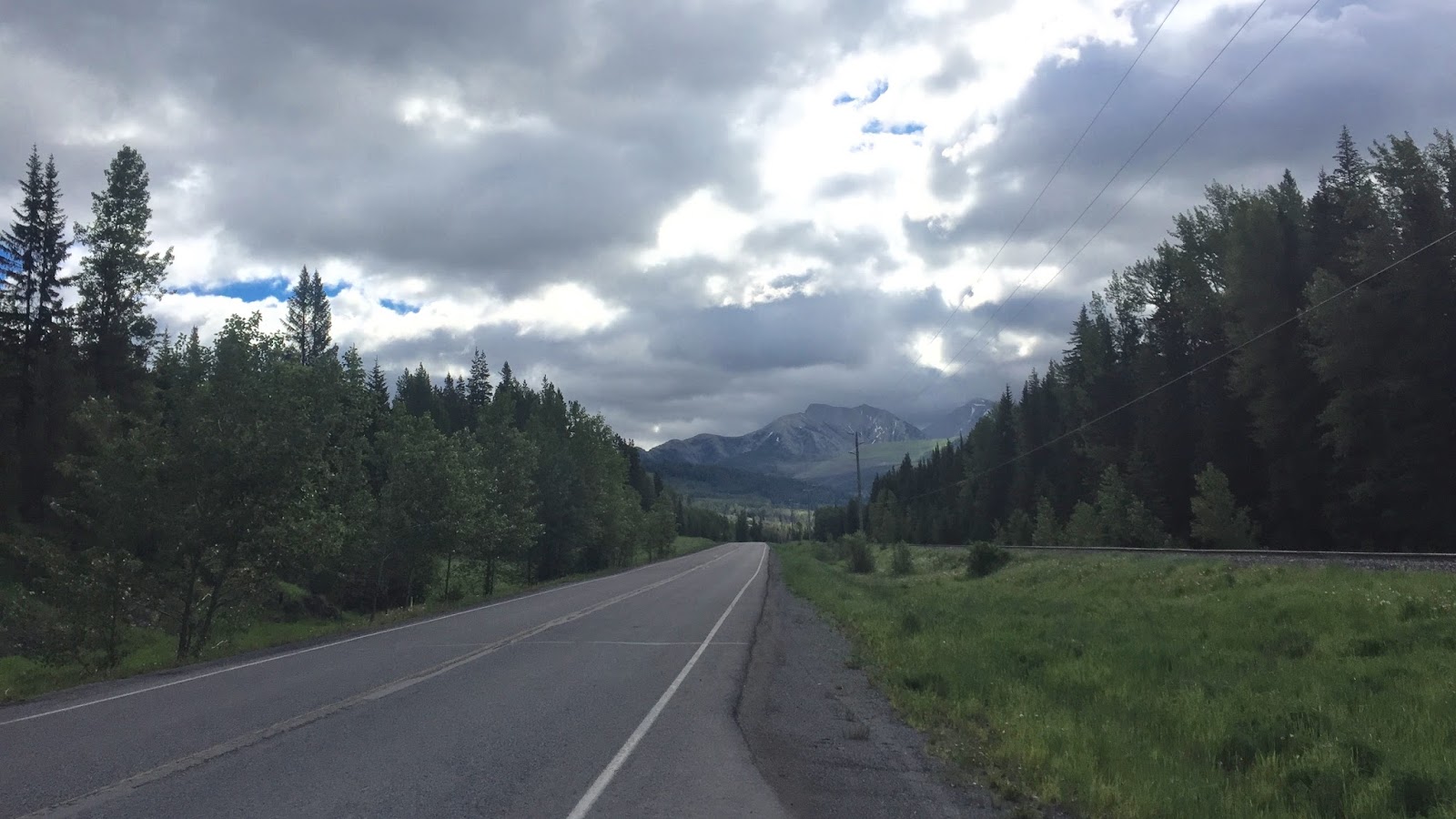
Corbin Road, on the way to Flathead Pass
By now, I had managed stuffed my expectations so proficiently, I almost couldn't hear them as they badgered me to press on, reminding me that it doesn't actually get dark up here for a couple more hours. Besides, since I had assumed I would be in hotels the first several nights, I failed to pack a rope with which to hang a food bag, and Rick let me double up with his. (Pro tip: bring a rope and bag for your food, and learn how to hang it properly. There were a couple of Euro-tourists at Wigwam who insisted on hanging their food bag right next to their tent - not the way to do it people.) Besides, strength in numbers at the campsite, I rationalized. Besides, fatigue. Stuff stuff stuff.

Highlight: Right after Butts Cabin, I happened on a campground where someone had put a big jug of water next to the road with a sign "welcome riders" or some such. I took it as providence, and refilled my water bladder. Also, when I arrived at Wigwam, Rick was feeding dates to a doe from his hand. It probably doesn't bode well for the deer (domesticated), but it was cool to see up close.


Day 4 Plan: Bigfork to Ovando (+/- mile 530)


Day 4 Reality: Wigwam to Red Meadow Lake (+/- mile 330)


I set off early, and made it to the base of the Wall around 9:00. The Wall has to be bad for Matt Lee's karma this time of year. Seriously, all those curses being called down on him every June? Ouch. I grunted my way slowly and carefully up the muddy, rooty path. No room for error here. I thought of the two riders I passed on Day 1 who were pulling loaded Bob trailers, and prayed that they scratched before they made it this far. Next was on to Galton Pass, which was brutal going up and brutal coming down. No smooth descents in Canada. I thought for sure I was burning my brake pads down to the metal as I picked my way down down the mountain. When I saw the manicured pastures on the valley floor, I almost cried. Pavement! Roosville! Montana! I resupplied at Subway in Eureka, then stopped at the laundromat to dry things out for a few minutes. On to Grave Creek Road and up to Whitefish Divide. I made it to Tuchuck by 7:00-ish, but wanting to make up for lost time (and still no rope for a food bag), I pushed on, hoping at the very least to make Upper Whitefish Lake. I hit the North Fork Flathead River valley just before sunset. The sunlight was streaming horizontally through the trees, dappling the road in front of me. And the aromatic from the trees made the whole valley smell like Christmas cookies. Spectacular. I made the Red Meadow turn just before dark, and started up. By now my right knee was starting to ache, limiting the amount of power I could put down. With a handful of miles left to Red Meadow Pass, I could no longer stay on the bike, and walked the last hour and a half. I arrived at Red Meadow Lake before midnight, discovering half a dozen other riders already set up for the night. Fatigued, I gladly joined them. (Pro tip: Red Meadow Lake has a food locker - no bear bag required - but if you can make Red Meadow Lake, it's just a hop and a skip to the pass, and then it's less than half an hour down to Upper Whitefish Lake. It's not a huge distance, but I wish I'd had a better sense of it that night and pressed on.)

Galton Pass
By now I was realizing that my 21-day plan was completely unrealistic. I had just finished my biggest day on a bike ever - which was still far short of my daily mileage goal - and was completely wiped out. In all honesty, I was going into a mental/emotional tailspin, unable to conceive of a plan or goal other than the ones I had set before I arrived in Banff. I've read advice from others about managing expectations, and thought I had prepared myself mentally for the possibility of losing time here and there. But as my plan started to unravel, I started to have a very difficult time reconciling myself to the truth of my situation: my plan was trashed. Now what?

Highlight: Beautiful weather all day long, all the way up to camp. I learned later that people following as close as the next morning had snow on Whitefish and hail on Red Meadow. Take your good days when you can get 'em!


Day 5 Plan: Ovando to Helena (mile 640)


Day 5 Reality: Red Meadow to Whitefish


Cold morning. It started off clear, but clouded over quick, and before I made the north end of Whitefish Lake it was raining. The pain in my right knee had now escalated from throbbing to stabbing. When you're cold and wet and in pain, it doesn't take long for weariness and panic to come knocking. I was elated to finally make it to Glacier Cyclery, then next door to Loula's, where the Lemon-Stuffed French Toast is sure to turn your morning right side up again. Back at Glacier, I was delighted to run into Josh Waters again, but was heartbroken to learn that he needed to pull the plug on his tour and was heading home. I decided to take a rest day, and booked a hotel. I also needed to replace some of my kit, which was not performing as I'd hoped, so I made the rounds to the local outdoor shops to see what was on offer. Back at the hotel, I ordered pizza from Jersey Boys, and went to bed early.

Red Meadow Lake at dawn
Highlight: The people of Whitefish. No kidding, from the moment I met Vanessa and Tyler at Glacier, through all my shopping at the Toggery, the White Room, and Sportsman - heck, even Safeway - everyone was kind and considerate and willing to refer me to their competitors in town if they didn't have what I needed. First class! Oh, and the Cowgirl Coffee shacks! In Whitefish you're never more than about a hundred paces from high quality caffeine, and the folks that staff the shacks are super.


Day 6 Plan: Helena to Wise River (mile 770)


Day 6 Reality: Whitefish to Swan Lake (mile 420)


By now, I was having misgivings about my knee's ability to hold it together. As such, I decided to do "half days" - roughly 60 miles per day - for the next few days to see if my knee could recover so I could carry on. I got up early to resupply, pick up new kit, and ship old stuff home. By the time I hit the road, it was already 11:00. It was another beautiful day as I made my way east from Whitefish to Columbia Falls, then south toward Swan River. I made it to the Echo Lake Cafe just after closing time at 3:00, but as I sat out front consulting my map and eating cold pizza, the owner stuck her head out the front door and asked if there was anything I needed. I was good on fuel and water, so I used the restroom and headed off. As I climbed up the hill on the west side of Swan Lake, Dave Schreiner caught up with me, and we walked the rest of the way up to the top of the hill, chatting all the way. We bombed the descent, and made the T-intersection at the bottom of the hill around 7:00. I was heading east toward Swan Lake Trading Post, but Dave was determined to make Holland Lake that night, and continued south. I made Swan Lake Trading Post and Campground where I inquired about the tent sites. As Joe the proprietor showed me around, he looked up and said "Ya know, it's supposed to rain tonight. C'mere." He led me around to the far side of the pond where they had three 2-man yurts set up. Upgrade! Sure enough, sometime after midnight, it started to rain. So nice to sleep dry.

Highlight: Between Whitefish and Columbia Falls, I had the chance to pedal alongside Dieter Borsutzky. We had actually crossed paths briefly on the connector between Elkford and Sparwood, and talked about where our journeys had taken us since then. Then he said to me "To my mind, there are two ways to do this kind of thing. Either you push-push-push as hard as you can, and need to take rest days to try to recover; or you soft-pedal and just, you know, keep going." Sage advice. I wish I had taken it.


Day 7 Plan: Wise River to Lima (mile 910)


Day 7 Reality: Swan Lake to Holland Lake Lodge (mile 480)


Rain. Joe made me a hearty egg & cheese breakfast sandwich (McSwan!) at the Trading Post before I set out. The segment from Swan Lake to Holland Lake looks deceptively easy on the ACA profiles, but in reality it seems like you're always climbing. By now, not only the knee was in pain, but also my left ankle, presumably from all the hike-a-bike. (Pro tip: Incorporate jogging/hiking/trail running into your training regimen. You'll be pushing your bike up hills more than you ever thought possible.) The rain stopped with a few miles to go, but between the pain and the wet and the mud and the cold, weariness was creeping in and thoughts of despair were at the door. I checked into the Holland Lake Lodge and called my wife. Knowing how much I'd done to prepare for this (and how much she'd sacrificed so I could chase this dream), she checked and double-checked (and triple-checked) with me to make sure my mind was made up - I was done. I know you're not supposed to quit at night, you're supposed to sleep on it and all that, but with my legs betraying me, I didn't feel it prudent to continue on to Richmond Peak and the high country that lay beyond. Downstairs I discovered that Dave Schreiner was still at the Lodge, so we had dinner together with another NoBo tourist named Chris. It was delightful. (Pro tip: Don't quit at night. Sleep on it. Then, take it a step further - get up the next morning, pack your bike as if you're going to press on, and take one more step. If after all that you decide to pull the plug, then do it. But not before.)

Highlight: Finding Dave Schreiner still at the Lodge lifted my spirit. Good company, good man.


Day 8 Plan: Lima to- seriously, why bother


Day 8 Reality: Scratched at Holland Lake Lodge


Holland Lake
I had an early breakfast at the Lodge bar with Dave Schreiner, then headed out to the lawn by the lake to snap some photos of him before he headed off to take on Richmond Peak. Back inside the Lodge, a couple who had overheard Dave and I at breakfast offered to drive me to Missoula (highlight!). In town I was too early to check into my hotel, so I rode my bike to the UPS Store, where it took me the better part of an hour to knock down my trusty steed and stuff it into a bike box.

And that was that.

So what happened?


How in the world did I fall so far short of my goals, and end up so wracked at the end of it?  I've mulled this over again and again, played "coulda, shoulda, woulda" over and over. There are a bunch of things I did poorly - major gaps in my training program, fuel and hydration management, and personal care (i.e. saddle sore prevention) among them - but I think the biggest thing for me was lack of experience. Early this year, I consulted a coach who reviewed the training plan I had assembled on my own. Coach suggested that the 10-hour, 12-hour, and 14-hour rides I had planned late in my training program were excessive. "Training isn't racing" Coach said, indicating that such long rides would over-stress the body, making adequate recovery difficult or impossible in the midst of heavy training. I think that for a seasoned racer, this is probably good advice, since the seasoned racer already has a deep well of experience to draw from when the going gets tough. However, for me - not a seasoned racer - those long training rides were more for developing the mental grit necessary to carry on when fatigue sets in. If I could do it over...

There were also kit failures that detracted from the ride. First, the ultralight backpack I started with was simply too light; I replaced it with an Osprey hydration pack with plenty of room for gear and food. Next, the Ibex merino Shak Classic mid-layer, once wet, would NOT dry out in a timely manner; I replaced it with a Patagonia R1 hoodie. Last, gloves! The DeFeet Charcoal ET wool gloves coupled with the Aerostitch Triple Digit waterproof/breathable shells did not work, as they wetted out within an hour of the onset of rain on Day 1. I replaced them with neoprene rafting gloves from Sportsman in Whitefish. The wetsuit gloves work - kinda. When the pace picks up and the gloves are wet inside and out, airflow across the outside of the gloves sucks the heat out of your fingers through the neoprene. Better than what I started with, but I am still in search of an adequate cold/wet glove solution. (One of the guys at Sportsman suggested keeping the wool liner + waterproof/breathable shell combo, but adding a waterproof glove, such as a dishwashing or surgical glove, next to the skin. Apparently this is something that mountaineers will do to prevent wetting out from the inside, which - if the shell is doing its job - is likely what was compromising my wool insulation layer. I was never brave enough to actually try this out, but it sounds promising, if a little counter-intuitive.) If you have a glove solution that works for you, post it in the comments. I'd love to hear it.

What went right?


On the upside, there were things that performed as well as - or better than - I'd hoped.  My customized Salsa Fargo was a champ; the Gevenalle GX shifters worked perfectly through training and on the trail; custom wheels (Velocity Blunt 35 rims; Hadely rear hub; Schmidt SON 28 15 front hub; 36 spoke 3-cross build by Peter White Cycles) have been bomb-proof over 5,000 miles of riding and racing, and Specialized Fast Trak tires roll fast over any kind of terrain. The Schmidt Edelux II light is adequate for road surfaces (though it does not illuminate overhead obstacles, low-hanging branches, etc.), and works with the SON hub down to walking pace. Handy for hiking uphill in the dark. Much of my kit was by Ground Effect, and almost without exception it exceeded expectations. Custom orthotics by the Sole Man AZ were awesome. Scott Abbey made it possible for me to ride more than 30 miles without searing pain in my left foot. Feet are no longer an issue for me. The Gore over-socks I borrowed from my friend Steve were a last-minute lifesaver. Coupled with DeFeet Woolie Boolie socks, my feet may have been damp from time to time, but they were never cold. My sleep system worked exactly as I needed it to: Tarptent Moment DW, Sea to Summit Ultralight Insulated Mat, and Zpacks 20 degree bag. The tent is not the smallest/lightest available, but with two stakes and one pole, it's super-simple to set up in the dark after a long day in the saddle. Relevate Designs handlebar harness and Terrapin holster coupled with Sea to Summit eVac dry sacks proved to be a great combination. I heard about lots of folks having GPS issues, but my Garmin eTrex 30x turned on and did its thing faithfully every day. My Sinewave Revolution and Limefuel Blast (previous generation) cache battery worked well, powering my iPhone and my GPS. And even though my ride didn't end the way I had hoped, at the end of the day I'm in the best shape of my life, and able to continue training for the next adventure.

Lessons learned


I picked this up at the airport
in Missoula. I highly
recommend it.
The Tour Divide is a tough teacher. I'm still learning lessons from my time out there. Set realistic goals and ride a realistic pace. Dieter's words about pacing still echo, and while I still think it's important to set goals, those goals should be anchored in your actual riding experience, whether that experience comes during racing or training. Ask yourself which is more important: finishing the course, or riding beyond your experience in order to put down a "competitive" time at the risk of possible injury? It was naive of me to think that my daily race mileage goals could be so much higher than my actual riding experience. That's the big lesson, but there are many others. Diversify your training. Run. Hike. Train for hike-a-bike. You'll be doing a lot of it. And practice everything. Practice until you don't have to think about it. Practice fueling and hydration. Be disciplined about it. Everything - body, soul, spirit - deteriorates when you're low on food or water. By the time you're hungry or thirsty, you're already behind. Know how your filtration and/or purification systems work. Know how to unwrap a Clif bar while riding the bike. Practice self-care of your nethers (read: saddle sore prevention), and be disciplined about that too. Practice setting up camp, then practice breaking down. It took me an embarrassingly long time to break camp in the mornings. Practice sleeping outside. For real. You're taxing your body more and getting less rest than you're used to, so you'd better be able to get some solid sleep in the few hours you have each night. Take supplements to help you sleep if you need to. Bring antibiotics to fend off opportunistic infections. Lots of riders scratched this year due to chest colds and the like. Above all, manage your expectations. Things will not go the way you think they will. And all that time on the turbo-trainer does nothing to prepare you for when things go sideways. Sometimes the toughest gap to bridge is the gap between expectations and reality. The better you get at bridging that gap, the more likely you are to succeed.

Take lots of pictures. Shoot lots of videos. Introduce yourself to others. Ask people's names. Don't be shy. Take pictures of them. Take pictures with them. It's astonishing how the brief encounters I had with people on the trail are the most vivid highlights of my trip. But the memories, the passes and the people, start to fade quick. Those pictures and videos will help to crystalize them for you. And know that no matter how quick or slow you go, whether you go the distance or pull the plug early like I did, it's going to go by way too soon. You did all the planning and training - for a year or more! - and suddenly it's over and you're back at home, watching dots on Trackleaders, typing up a ride report, and wondering how it's all over so quick. Savor every minute, no matter what that minute brings you.

Will I attempt the Tour Divide again? Yes, I think I will, for a few reasons. First, it would be a shame to have learned as much as I have and not get out there and try it again. Second, it gives me a broader goal to shoot for with regard to my overall health and fitness. I like that. (Plus, it gives me a somewhat legitimate excuse to obsess about bikes, which I've always loved.) Last of all is a lesson I learned at the Wall. When I posted the photo of the Wall on Facebook, I noted that "Things like the Wall are just thrown in to spice things up. I may forget which mountain pass is which, but I will never forget the Wall." In a broader sense, adventures like this, should we choose to pursue them, afford us opportunities to add something unique to our lives. When I'm 80, I won't care (or likely remember) the time I spent in an office or mowing my lawn. I will never forget the Tour Divide.

By the way, Dieter Borsutzky arrived at Antelope Wells earlier this evening. Chapeau, sir.

Check out more photos from my journey here.

-David

.

Friday, June 3, 2016

From Dream to Reality

One week.

In one week, I'll be in Banff, Alberta, lining up to race the 2016 Tour Divide.

All the training is behind me now.  My last long ride was last weekend.  My last weight training session was Wednesday.  My last threshold workout on the trainer was yesterday.

The last of the shopping is done.  I made my last trip to my LBS yesterday (brake pads and tire sealant), and when I got home, UPS had delivered my last last-minute purchases (a replacement Craft ultralight mesh vest and a Veleau tube).

All that's left is to tear the bike down, replace all the worn parts, check my pack list, squeeze everything into a box, and show up at the airport.

"After" photo by John Schilling. Thanks John!
To say I'm distracted is an understatement.

And yet there was a time when none of this would have been remotely possible.

I've been dreaming about the Tour Divide since I read about it in 2008, but as recently as 2012 I was so out of shape that I got winded riding the short loop at McDowell Mountain Park.  It's three miles, and I had to stop three times because I thought my lungs were going to explode.  I was also seriously overweight, with a BMI teetering on obesity.  Tour Divide was little more than a pipe dream.

Then my wife clued me in to Take Shape For Life - she's a TSFL Certified Health Coach - and I started to get serious about getting the weight back into a healthy range.  Over time I worked on my overall fitness, until voilá - I was finally in a place physically, mentally, and emotionally, where I could seriously think about doing this thing.

Now I'm a health coach too.  Together, my wife and I help others pursue optimal health, so they can turn their dreams into reality.  Maybe ultra-endurance cycling isn't your thing, but whatever it is you dream about - whatever is on your "wouldn't it be cool if I could do that..." list - we can help.

It's never too late to be what you might have been.  -George Eliot

It's true.  I'm living proof.

-David

Tuesday, May 31, 2016

The Last Hurdle

Today I went and had my knee checked out by Dr. Michael Lee in Phoenix.  My knee does this clicking thing, and I wanted to be sure there wasn't structural damage in the joint before I try to ride my bike 2,700+ miles.  Dr. Lee was recommended by several people, so I scheduled an appointment.

The med tech shot some x-rays, and I was ushered into an exam room with posters displaying what can only be described as exploded views of various joints in the human body.  I stared at the knee poster for about 40 minutes, wondering which of the ligaments was dragging across which of the bones to produce the clicking sensation.  Is it the iliotibial band?  The fibular cruciate ligament?  The tibial tuberosity?  Who the heck is naming these body parts anyway?

Dr. Lee came in.  Very upbeat.  He said that from the x-rays, my knees look great.  Then he examined the knee, bending it every which way, squeezing and pinching, to see if there were any pain points.  None.  He said there was some minor inflammation, but that at this point he wouldn't even recommend an injection.  "Just take some anti-inflammatories with you."  Vitamin I (ibuprofen) and I are friends already, so I had no objections.

So- Thumbs up!  Green light!  All systems go!

That was the last possible thing that may have stopped me from boarding the plane to Calgary next week.  All that's left now is to get my hair cut, pack my bike in a box, and hitch a ride to the airport.

See y'all in Banff!

-David


Wednesday, May 25, 2016

Tour Divide Tracker is Live!

The Tour Divide tracking map is live!  Check it out (and preview the course) at

http://trackleaders.com/tourdivide16

Race day is still two weeks out, so not a lot of action out there yet.  In the days leading up to the Grand Depart, you'll start to see little blue & pink dots populate the map, converging on Banff, Alberta, Canada.  I'll be in the mix (look for DP), starting in Banff and racing southbound (sobo in TD parlance).  There will also be a smaller number of dots converging on the south end of the route - those represent the racers who are racing northbound (nobo).

You'll likely see other dot colors as the race progresses.  Yellow dots are for those challenging the course purely as an individual time trial (ITT), which means they're racing, but they're not participating in the Grand Depart on June 10.  You'll see yellow dots on the map all summer long. White dots are for those who choose to tour rather than race the route.  Has to do with pacing.  Want to stop and smell the flowers, and check social media at every available hot spot?  You're probably not racing; white dot for you.  Orange dots are for those who have deviated from the course - intentionally or otherwise - and have not gone back to the point of departure before continuing forward on the route.  That's a violation of the rules; orange dot for you.

This is as close to live coverage as you're going to get for this event.  I've been watching dots on maps for years now, and I'll warn you - it's addictive.

Who knows - maybe you'll end up being a dot on a map someday.

We should all be so lucky.

-David


Sunday, May 22, 2016

Fast Forward

<tap> <tap> Is this thing on?

Let's cut to the chase: I'm racing the Tour Divide this year. Or rather, I'm going to attempt the Tour Divide this year.

A year and a half ago I'd been planning on doing the Tour Divide in 2015. Then I decided not to. And that was that. I though my whole Tour Divide dream was over.

But then something happened I hadn't anticipated. Without that dream, that goal, pulling me forward, I started to spiral down into an emotional slump. With my mental and emotional state in decline, my physical health soon followed. I was a sedentary, chronic grump. It was not pretty. Ask my wife.

So in February or March of 2015, I decided to get back on the horse. I assembled a training plan (I'm too cheap to hire a full-time coach at this point), and started training in earnest last summer. Training has gone well, and although I have't hit all my goals, I've made some serious gains. Bike and gear are sorted, maps pored over, and logistics studied ad nauseam.

I think I'm ready. Or as ready as I can be as a TD Rookie.

Okay, there is one last appointment with an orthopedist to check out this thing with my knee, but it's more for curiosity than to suss out an actual problem (fingers crossed), so I don't anticipate any real snag there. We'll see.

I deliberately didn't blog about my preparations this time around, 'cause what if I bail again? Why humiliate myself. Again. At this point, though, the plane ticket is paid for, and I've got a reservation at the Y in Banff. All that's left is to taper, pack up the bike, and show up.

In two weeks.

Yes, June 10 is race day. I fly to Calgary on the 8th. I'll post details about how you can follow along once the race is underway, if you're so inclined.

So yeah, getting down to the last minute. Starting to get nervous now. Is this really happening? Yes, yes it is.

Wish me luck.

-David

Wednesday, January 28, 2015

Squeaks & Creaks

So I have a creak in the bottom bracket (SRAM GXP) on my Salsa Fargo. Spent much of yesterday trying to eliminate it without success. By day's end, I had replaced the old BB with a new one, but only after removing/reinstalling, cleaning and re-packing the original BB several times. Also torqued the spider and chainring bolts to spec and re-greased the crank spindle where the arm bolts on. 

By bedtime, it was still squeaking. If anything, it was getting worse. Grr.
What could it be? Did some Googling. Pedals? Derailleur hanger(s)? Thud-buster seat post? Alternator dropouts? My money's on the dropouts. Folks have had all kinds of issues with them, and have tried all kinds of remedies to, well, remedy those issues.

Woke up this morning prepared to wage greasy war on all bolts and slider plates anywhere on the back half of the bike.

But first, I decided to swap out the custom wheel for the factory wheel and test it out. 'Cause I mean, what if it's the rear hub on my spendy custom wheel? So I swapped wheels and went for a spin.  

No creak.

Oh darn. (Or something like that.) Must be the hub, right? So not looking forward to breaking down and rebuilding my Hadley.

So I sigh, take the factory wheel back off, sigh again, put the custom back on, and flip the skewer shut. Hmm, seems a little loose. Undo, cinch it up tight, and lever it shut. Just for grins, I take it out.

Guess what. No creaking.

So, the creak appears to have been coming from the rear dropout, because maybe the QR wiggled loose over the past month? It's been about that long since the rear wheel has been off the bike. Hoping the creak stays gone. So far, so good.

Sometimes it's the little things.


Thursday, December 18, 2014

Tour Divide - Changing Gears

This is a tough one.

I've been wrestling with this for a while, but I'm pulling out for Tour Divide 2015.

I'll be honest, gearing up is expensive, and the training is kicking my butt, but when it comes down to it, I'm struggling with the time commitment - not just the time commitment for training, but also for the event itself.  My son Julian is ten years old, and at a really formative time in his life.  I remember what life was like for me at that age, and what a piss-ant I turned into when my dad was gone on business, sometimes for weeks at a time.  I think my mom and sister dreaded those weeks.  Anyway, the fact that participating in the TD is purely voluntary has me questioning my motivations & priorities.

I'm not sure what this means for my long term goals (2016 and beyond).  Gotta figure out what I really want out of this, and whether it's about the route, or about the race.  I want to figure out some way of including my family in this endeavor if I'm going to do it in the next few years.  Maybe it means I end up touring the route (or select parts of it), with them following in a support vehicle?  Maybe I race it in some other season of life.  Maybe something else altogether.  I don't know yet, still trying to figure it all out.  All I know is someday our son won't live with us anymore, and I don't want any regrets then about how I live my life now.

I'll continue to train, though probably less aggressively than I have been up to now.  More of a maintenance program, maybe throw some single track into the mix again.  I've been doing mainly gravel roads for the past several months, and my trail bike is convinced I don't love it anymore.  And it'll give me a chance to get the Fargo dialed in for future outings:  I'd love to put a Lauf fork on it, and maybe even a Rohloff/Gates drivetrain, neither of which I can afford at present.

So, I still have goals.  For the time being though, the Tour Divide has to go on the back burner.

But I will still watch the blue dots next summer.

-David

Thursday, November 27, 2014

Tour Divide - Weighing In

Happy Thanksgiving everyone!

As we emerge from our tryptophan-induced naps, I want to revisit something I wrote about back in September. I had mentioned my plans to drop some weight at the beginning of my Tour Divide training process, instead of trying to do it along the way, or (shudder) wait until just before race day. Not long ago, I read an interesting piece on the Carmichael Training Systems blog that does a great job explaining why I approached it the way I did. In particular, it articulates why it's important to view shedding unnecessary weight as its own training phase, instead of trying to drop pounds while building mileage:

Fall (read: off season) is also a great time of year to focus on weight loss because if this isn’t a focused race season for you then you can make changes to your caloric intake and nutritional composition with little to no risk to your training quality. Many athletes try to restrict calories and lose weight in the spring, but that creates a conflict between your nutritional needs for high-quality training and the caloric restriction necessary for weight loss. It’s better to focus on weight loss during the period of the year when your training goals are less specific.

Couldn't have said it better myself. The conflict they talk about is exactly what I wanted to avoid, and why I focused on weight loss before the real training mileage began. Well, I'm happy to report that I dropped ten pounds since that post: I'm currently 175 lbs, which, on my 6'3" frame, puts me at a BMI of about 22. Still five pounds away from my ultimate goal of 170 lbs, but good enough for me to transition out of "meltdown" mode and firmly into "mileage" mode.

See, the program I use to burn unnecessary fat doesn't allow for prolonged periods of exercise. I know it seems counter-intuitive, but there are some very good reasons for this that have to do with stress hormones, glycogen reserves, and other things that impact the way our bodies burn fat. As such, my exercise had been limited to an hour a day for the time I was on program. The hardest part of shedding weight is allowing for the passage of time. Just allowing the program to do its thing.

Patience. Ugh.

But in all seriousness, the program works - if you let it. And it's only taken a few weeks to achieve something that could very well have gone unaddressed. If you're interested in freeing yourself of unnecessary poundage the way I did - whether we're talking 5, 15, 50, or more - check out my contact information in the sidebar. I'm happy to talk you through the program and how we can make it work for you.

[Side-note: if your reaction to my suggestion is "but it's the holidays..." then I have a challenge for you. Food-wise, 'the holidays' consists of two or three meals over the span of a month. This being the case, are you really going to sacrifice a month's worth of potential progress because of a couple of 'off-program' meals? Check out my wife's blog on the subject for some additional food for thought. And even if you want to wait until the new year to get started, let's talk now and set you up for success come January 1.]

Now that I've transitioned back into a weight maintenance phase, I can build mileage in earnest. I'll write more about my approach to training later. Right now I have to get the bike ready to ride in the morning. It's gonna be a beautiful day.

-David

Sunday, November 23, 2014

Tour Divide - Rules Are Rules

As riders, we’re attracted to events like the Tour Divide in part because of the rules.  And when I say “rules” I mean those listed on the tourdivide website – not the ongoing flame war on the bikepacking forum.  The rules are simple, and they’re tough.


  • Stick to the course.  No exceptions.
  • Advance forward on the route under your own power.  No motors, no drafting.  Sweat & oxygen only.
  • No help from outsiders, unless the "outsider" is a commercial establishment that is open to the public.
  • And if you break a rule for any reason, have the stones to self-relegate.


Solo.  Self-support.  Basically, do it on your own.  All bound up in nothing more and nothing less than a "gentlemen's agreement."  Nothing to win or lose but honor.  Pretty straightforward.

That being said, there are those every year who view the rules as more or less flexible, more like guidelines, to quote a certain pirate captain.  And there are others watching on trackleaders who notice, and wonder why said rule-bending racers haven't self-relegated.  And then there are others who seem to think that the rules as written are too stringent, and isn't it really up to the individual racer's interpretation and intention as to what kind of race they really want to be a part of?  And there are others (I'm losing track here...) who think there should be multiple classes of riders, presumably one for each group of a-la-carte rule-sets being followed at any given moment.

Yeah, makes no sense to me either.  Eszter summed it up perfectly in her post: "We didn't have issues following the rules of 4-square when we were all in second grade.  Why now?"

Exactly.  The rules are what make it a race, and they don’t need to be changed.*  Don't want to follow the rules as written?  No problem.  Lucky for your, there’s already another class of Great Divide rider.  It’s called tourist.  It just doesn’t come with the prestige of having your pointy blue dot chasing its way down the continent with all the others on the race page at trackleaders (though friends and family can follow along on the GDMBR general live tracker).  Maybe that’s a tough pill for those who want to be seen rolling with the fast crowd.

As for me, I’m not 100% which way I’m going to go in 2015 – racing or touring.  I’m one of those for whom this will be my first foray into multi-day racing.  Would I like to see my blue dot (more to the point, would I like to have others see my blue dot) on the race page at trackleaders?  Heck yeah!  Do I plan to uphold the rules as written?  I do.  But my primary goal is going to be learning – learning the course, learning what I’m capable of, learning how to do be a part of this crazy sport.  Is that really racing?  I don’t even know.  But unless I put that pressure on myself – the expectation that I’m going to push myself at something like a race pace – my outing could easily devolve into a leisurely tour.  And that’s not what I want.

Somewhere in that "Spirit of the Tour Divide" forum, someone suggested that a commitment to follow the rules be a part of a prospective racer's letter of intent.  I don't know why that never crossed my mind when I wrote my "blog of intent", but I think it's a good idea.  So consider this an addendum to my letter of intent.

I’ll be racing.  And I’ll play by the rules.  And if I end up breaking a rule for any of a million reasons, well, hopefully you’ll hear about it from me first.

-David

*Okay, I realize I just said the rules don't need to be changed, but I'd like to add one.  Call it the "good sam" clause.  If someone is in need of assistance - maybe she snapped a quick-link in grizzly country, or maybe he's face down in a ditch and the buzzards are circling - have the decency and/or courtesy to offer a helping hand.  What do you have to lose?  You won't be penalized for it, and whether they self-relegate or not, well, that's up to them.  Heck, they may not even accept your offer.  But at least you'll go to sleep at night knowing you're a decent human being.

Saturday, November 1, 2014

Tour Divide 2015 - Be Prepared

Quick post.  In the name of being prepared for this crazy Tour, I'm taking a NOLS Wilderness First Aid course this weekend at REI.  It's a two-day course, and today was day one.  Holy cow, it's like drinking from a fire hose!  And this is the 101-level "introductory" course.

Don't get me wrong - the course is great and the instructors are awesome.  I just didn't know how much I didn't know!  Hopefully, once all the new info has had a chance to soak in, I will at the very least know what everything in my First Aid kit is for.

And who knows?  Maybe someday I can put some of this information to use helping someone besides myself.

In the mean time, I need to get ready for bed.  Tomorrow is day two.


Saturday, October 25, 2014

Tour Divide 2015: Cracking the Nut

Now that I'm in this thing, how am I gonna get it done?  The more I ponder the possibilities - and assuming I actually can get it done - the more the following three things come to the surface.

Go alone.  Learn.  Keep moving.

Go alone.

First, I'm going alone.  Technically, anyone who challenges the Tour Divide does so as an ITT - Individual Time Trial.  Man against the clock.  The rules say that "Divide racing may be challenged at any time."  They then go on to say "TD emphasis is on a second Friday in June (southbound) 'grand départ.'"  That's when most southbound Tour Divide challengers congregate in Banff (or, if nobo, in Antelope Wells) for the grand départ.

I will not be among them.  I'm not anti-social or anything, but I'm waiting until late July to fly to Banff and point my bike south.

There are a couple of reasons for this.  First is weather, which, on the Tour Divide is like a box of chocolates.  But after watching the GD racers get pounded by the elements for a week straight this year, I'm hedging my bets, and hoping things have dried out by the time I start my run.  Not sure what this will mean when I hit New Mexico during monsoon season, but unless I start in September, monsoon season is going to be hard to avoid anyway.

The second reason is my own weakness when it comes to riding with others.  By going solo, I can circumvent my own propensity to try to keep up with stronger racers.  Maybe you can ride with others and not fall into this trap, but for me, it seems like no matter how I try, if there's a carrot out there in front of me, I'm a-gonna go for it.  Long ride, short ride, doesn't matter.  I can't help myself.  I know it's a trap, and I fall into it every time.

"Dave, see that trap?"

Yup. 

"You sure?  That trap right in front of you?"

I see it.

"Really?  'Cause it looks like you're about to step into it."

I'm good, I got this.

"Okay, go!"

Smack!  I fall into the trap.  I've pushed too hard and blown myself up, and within a hour, all I want to do is lie down in the ditch and take a nap.  

Pacing.  Sticks and carrots.  Impulse control.  Guarding my reserves.

Still working on those.

Learn.

In The Cordillera V5, one of the things that really stayed with me was Erick Armentrout's observation that "The first time you race the Divide you're not racing, you're learning.  When you come back you're racing."  Actually, this advice came from someone Erick met at the mercantile in Hartsel, Colorado.  In any case, it had the sound of wisdom, so this is the approach I'm taking on this, my rookie attempt.  Whether or not I ever return to "race" the Divide, well, we'll just have to wait and see about that.

When I talked about this approach with a friend, he coined the term "fast recon".  It's still racing, but I'm not out there to smash records or even approach the podium.  Frankly, I'd be thrilled with a qualified finish.  25 days is pretty much the outside limit of what is considered a competitive run for men, so that's my baseline.  There are so many variables out there, so many unknowns.  If I can shave a day or two off, great!  But this is my rookie run.  If I can make it to Antelope Wells in one piece, I'll take it.

Keep moving.

In the trailer for Ride The Divide, Matthew Lee gives away his secret to a successful run.  "Always need to keep moving, keep moving, keep moving.  Always."  I think that's the name of the game.  I don't necessarily need to move fast - unless there's a tailwind, or a descent, or both (score!) - but I do need to keep moving.  I think I remember one top-ten finisher saying "I don't ride faster than anyone else; I just sleep less."  Be smart about the time I take off the bike.  I mean, I'll take time to take pictures, smell the flowers and chat with the locals when opportunity presents itself.  But no lazing about in town when there's trail to be taken.

That's the strategy.  Preserve my capacities.  Learn all I can.  Always keep moving.  Finish.

And maybe someday I'll get to come back and really race this thing.

-David

Saturday, October 18, 2014

Tour Divide 2015 - Contact Part 3: Feet

If you've been following this journey to the Tour Divide, my writing style may suggest that I know exactly what I am doing.  While I'm not a total doof, I am making a lot of this up as I go, gleaning information from what I hope are reliable sources and building on my own experience.  In some cases, I'm pretty confident in my decision making.  In others, I'm, uh, less confident.

Which brings us to the feet.

Feet are probably the most important contact points, simply because it's through the feet that power is transferred from body to bicycle.  As such, the feet are subject to stresses that hands and butt just don't experience.  Of course, I've never had a saddle sore on a hand or a foot, so I guess each contact point has its own set of challenges.  

At any rate, foot & ankle injuries are among the most common on the Tour Divide, for any number of reasons: repetitive stress, lack of support, poorly fitting shoes, poorly designed shoes, internal physiologic/anatomical issues, bad posture, cheap laces, crashing, rocks...  The list goes on. 

My feet are different.  Literally.  My left foot tends to pronate more than the right one.  In other words, it's flatter.  Also, after 15 or 20 miles on the bike, a wave of pain swells between the third and fourth toes of the left foot.  It hurts enough to adversely affect my pedaling.  If I pedal long enough, it'll start in the right foot as well, but not as much.  I'm not sure if we're talking neuroma or metatarsalgia, but it feels like someone has cut off my toes and drilled into the nerves - kinda like this:

Ouch.  Image courtesy of Cyclologic's facebook page.
So I start looking into custom footbeds.  This is my first experience with orthotics, and so far, it's a work in progress.  I go to the place, put my foot on the thing, they take digital impressions, and a week later I have custom footbeds for my MTB cycling shoes.  They look cool.  I go for a ride.  Right foot feels fine; the left foot waits 30 miles before it lets loose the familiar wave of pain.  Poop.

Back to the ortho guy.  He sands down the underside of the footbed to further refine the shape, and gives me a foam pad with an adhesive back to apply to the footbed, in order to better support the metatarsal heads and open up the space between the third and forth toes.  We're hoping this provides relief by easing pressure on that red nerve in the picture above.  Then I go for a long ride up in the mountains.  I do not find the relief I seek.

If anything could take me out if the race, this is it.  I'm working with Cyclologic and an orthotics specialist at Endurance Rehab to get this worked out.  If orthotics don't take care of the problem, they're talking injections or surgery.  Not being a fan of surgical intervention if it can be avoided, I'm looking into everything with regard to this issue, including natural medicine and other means of support.  Right now the custom footbeds are sitting on a shelf, and I'm experimenting with Correct Toes and Pedag metatarsal pads on a factory footbed, but I can't tell you how this arrangement works yet because I have yet to do any honest-to-goodness long rides on them.  

Oh, and did I mention I'm using hiking shoes now?  "Whoa, hiking shoes?  What happened to the MTB cycling shoes?"  Remember when I said I'm making this up as I go?  

Okay, shoes & pedals.  Initially, I had decided to use SPD pedals and a cycling shoe with all-Velcro enclosure, as this kind of shoe fits in with my "fewest moving parts" philosophy.  I don't want to be in the middle of nowhere and have a some exotic binding system crap out on me.  Simpler is better IMHO.  I tried the Mavic Pulse shoe, but as soon as I slipped it on, I could tell the bridges of my feet weren't happy.  Back they went.  Next I ordered up a pair of Shimano XC30's, a decent and inexpensive all-Velcro-closure cross country shoe.  They're comfortable and, aforementioned orthotic issues notwithstanding, they do what they're supposed to.

But I've discovered some tradeoffs that I'm not sure I can live with if I keep these shoes for the Tour Divide.  First is mud.  Nothing new here - riders have had to deal with mud in pedals and cleats for as long as there have been pedal cleats.  But it is pretty inconvenient, and all but negates the pedal/cleat interface until the mud can be cleared.  The second issue, however, is the big one, and it has to do with heel & ankle support.


Shoes: biking vs. hiking.
So check it out: the shoe on the left is the Shimano cycling shoe; the shoe on the right is my Adidas hiking shoe.  Which one is going to do a better job supporting my heel & ankle during a hike-a-bike?  The one with the wider foundation.  The effect is so pronounced that whenever I wear the cycling shoe I have to pay special attention whenever I dismount on uneven terrain - and by uneven, I mean loose gravel on the sidewalk - lest I roll my ankle.  It's like walking on high heels (so I'm told).  I can't imagine having to rely on these things to support me across miles of HAB (hike-a-bike) over rocky terrain, downed trees, avalanche debris, and water crossings.  I've thought about wearing some kind of brace to add support to the ankle, but that doesn't address the narrower heel platform.  Essentially just a band-aid fix to a much bigger problem.  Now, other shoe manufacturers have other shoes that have wider heel platforms.  Even Shimano is coming out with new "trail" shoes for 2015 that look promising.  But then you're still dealing with cleats and mud.  What to do?

Some folks swear by clipless pedals, no matter what.  Some swear by flats.  Which basically means it's a matter of personal preference.  Although I'm pretty solid on my understanding of the virtues of clip-in pedals, I am now experimenting with flats. Kent Petersen, who was the first person to complete the Great Divide Race on a single speed back in 2005, did it on flat pedals.  Check out his entry for June 21 for his perspective on clipless vs. flats.  Read the rest of the story too - it's a fascinating account of an incredible journey.  Then, the folks at Rivendale Bikes have a thing or two to say in favor of flat pedals.  There's even a Flat Pedal Manifesto.  Apparently I'm not alone in my search for a suitable foot/pedal interface. 

So at the moment, it's off-the-shelf orthotic products in hiking shoes with the factory footbeds.  But again - still learning, still making stuff up as I go.  Gotta put some serious miles behind me with this configuration before I can determine whether or not it's going to work.  I have some long rides booked in the next couple weeks, so I'll post an update when I know more.  Until then...

-David


Saturday, October 11, 2014

Tour Divide 2015 - Contact Part 2: Butt

There is nothing quite like the exquisite misery that is delivered by a saddle sore.  It's one of those things where you think you can keep pushing, just muscle through the pain, not realizing you're opening yourself up to an infection that can take you out of the game for days, if not weeks.

There are several things you can do to reduce the possibility of toxic ass-et syndrome: shorts and padding, chamois cream, training mileage, personal hygiene, and the saddle.

Ah, the saddle.

Berthoud Aspin.  As seen on eBay.
I've already mentioned how when I bought my bike, I allowed vanity to enter into my saddle selection, and bought a Gilles Berthoud Aspin touring saddle.  It was a thing of beauty.  But it never quite felt right.  When I went for my bike fitting, I discovered why.

Stephen Merz at Cyclologic is my bike fitter, and one of the services Cyclologic provides is saddle pressure analysis.  With the bike mounted in a trainer, he slips this electronic boot thingy over the saddle, you get on and start to pedal.  As you pedal, he can see in real time where pressure is loading and unloading on the saddle through the cycle of the pedal stroke.  If there are any potentially hazardous pressure points - i.e. under the sit bones - he can see it on his screen.

Before we continue, a little anatomy lesson: what are "sit bones?"

Sit bones (ischial tuberosities) are the part of the pelvis you sit on.  Think of them like the curved runners on a rocking chair.  When you sit erect on a chair, you're actually tipped up on the rear points of the rocking chair runners.  This upright posture isn't so bad because the seat of the chair has enough surface area to disperse pressure to the rest of your butt and thighs, and allows you to move around when you get uncomfortable.  Not so on a bike saddle.  When you sit upright on a bike saddle, the rear points of the sit bones exert pressure on the tissue between the bones and the saddle.

This video shows a tale of two saddles.  My two saddles in fact.  The one on the right is the Berthoud.  As it plays, you'll notice that there are three major pressure points, and they don't move around much.  The points on the left and right are under the rear ends of the sit bones, and the fact that they don't move around tells me that the tissue between the bones is not being unloaded during the pedal stroke, and is therefore less able to recover as I ride.  Concentrated pressure over time leads to tissue fatigue and eventually to saddle sores.  Ouch.

This could be mitigated if I were able to roll my pelvis forward on the saddle as I ride, off of the rear "tips" and onto the longer "runners."  In this position, the shape of the sit bones allows for a wider dispersion of pressure, and the motion of the pedal stroke should allow the sit bones to rock back and forth, allowing for pressure to load and unload on any given point.  But I'm unable to lean forward on this saddle because of the third pressure point.  The one in the middle.  If I were to roll forward on the pelvis, I'd be increasing pressure in the, um, center area.  Such pressure can lead to more than just saddle sores.

Cobb Randée.
So Stephen introduced me to the Randée, a new saddle from Cobb specifically designed for folks doing brevet-style all-day-in-the-saddle kind of events.  I spent one hour on a trainer with Randée, and immediately put my Berthoud up on eBay.  In the video above, Randée is the saddle on the left.  The shape of the Randée allows me to roll my pelvis forward onto the "rockers" of the sit bones, reducing concentrated pressure on the tissue supporting the pelvis without increasing pressure in the middle.  The pressure points that do flare up during the pedal stroke tend to move around, which shows that the tissue beneath the sit bones is better able to unload - and get some relief - during each pedal stroke.  Overall, a much better scenario for long days in the saddle.

For chamois cream, DZ Nuts comes highly recommended, so I'm trying that out.  For shorts, I'm currently wearing DeSoto 400 Mile shorts, which have a 14mm (!) pad, and some high-tech wizardry involving tiny embedded ceramic beads to reduce friction between the saddle and the shorts.  The best part, though, is that they actually provide a degree of compression - more so than typical riding shorts - which is supposed to help stave off muscle fatigue.  So far, I like them.  Order large though - these things are snug!

Everyone's anatomy is unique.  I really wanted the Berthoud saddle to be the one for me, but sometimes things just don't fit together the way we want them to.  I can't recommend one saddle or pair of shorts over another to anybody.  But I absolutely recommend a saddle pressure analysis like the one performed by Cyclologic.  In my view, it's an essential part of the fitting process.

-David

Friday, October 3, 2014

Tour Divide 2015 - Contact Part 1: Hands

When riding a bike, you come into contact with it in three places: hands, feet, and butt.  Okay, technically that's five contact points, but you get the idea.  When riding that bike for miles and miles and miles and hours and days and weeks, it's important to think about how you interface with those contact points.  Minor irritations on a weekend ride with your buddies can turn into unwanted game changers when undertaking a multi-day bikepacking race.  The last thing you want when you're headed to the middle of nowhere is for your bike to rub you the wrong way.  Literally.

The "look."
So, hands...

But before I get into that, I have a confession.

I'm usually a pretty pragmatic guy, but when I ordered my bike, I have to admit to some degree of vanity.  See, I was going for a "look."  Those of you seasoned enough to know better are already grinning at my folly.  Anyway, when I ordered the bike, I also ordered a Gilles Berthoud Aspin touring saddle, a beautiful natural leather French-made piece of bicycle art, and matching leather handlebar wrap.  I even bought vintage-looking ElevenGear riding gloves.

Quite the ensemble.

Now, I did take the extra measure of wrapping the bars with an under-layer of Specialized Bar Phat.  I mean, it's gonna be rough out there.  Gotta treat your hands right, right?

Then I took it all out and rode the Chino Grinder, and I learned a few things about contact points.  I'll save the saddle discussion for another time, but here's what I learned about that pretty, smooth leather bar wrap: it's slippery.  Especially with matching leather gloves.  Especially on gravel roads.  With washboard.  I only rode the short course, but after 42 miles, my forearms were sore from simply trying to hold on to the handlebars.  No way this stuff was going to go any serious distance.

So, off it came.  I kept the padding, but switched out the leather for Lizard Skin bar tape.  Very tacky, very grippy, and in combination with the Bar Phat, very cush.  So far, it's been great.

I haven't finalized on gloves yet.  I like the carpenter's gloves I've been using on my trail bike - simple, cheap and durable protection, although they have no padding to speak of.  I do still dig the ElevenGear gloves for warm, dry riding.  They offer less finger protection, but offer some modest padding in the palm.  And did I mention that they look cool?  Not sure if either are going to do the job just yet.  Decisions, decisions.

I haven't bought thermal or wet-weather gloves yet.  After the horror stories I've heard from those who rode in the 2014 TD (Grand Depart), I'm uncertain which way to go.

For rain, I was keen on the Mountain Hardwear gloves that Marshal Bird was going to take out, but after reading about his experience, I'm thinking twice.  I've heard similar stories about other brands of "waterproof breathable" gloves too.  So at this point, I'm looking elsewhere to find something appropriate.  So far the most promising thing I've found is from the world of motorcycle touring.  My favorite so far is the Aerostich short gauntlet rain covers, but even Aerostich offers a bullet-proof (and cheap) alternative: industrial dish gloves.  At $4 a pair, I'll probably throw a pair of these in my kit for good measure.

As for thermal gloves, I was looking at the DeFeet Wool Duraglove.  Simple, inexpensive, Merino wool.  Pretty tough to beat.  Then when it came time to pony up, my size was not available.  Come to find out the Wool Duraglove is being discontinued, as DeFeet is introducing a Wool ET (electronic touch) Duraglove to replace it.  It's only a couple dollars more than the original, and is designed to be used with touch-screen devices.  Handy when futzing with the GPS or making a phone call with the smart phone.

Looks like these just came online, so if you'll excuse me, I gots me some shopping to do.

-David